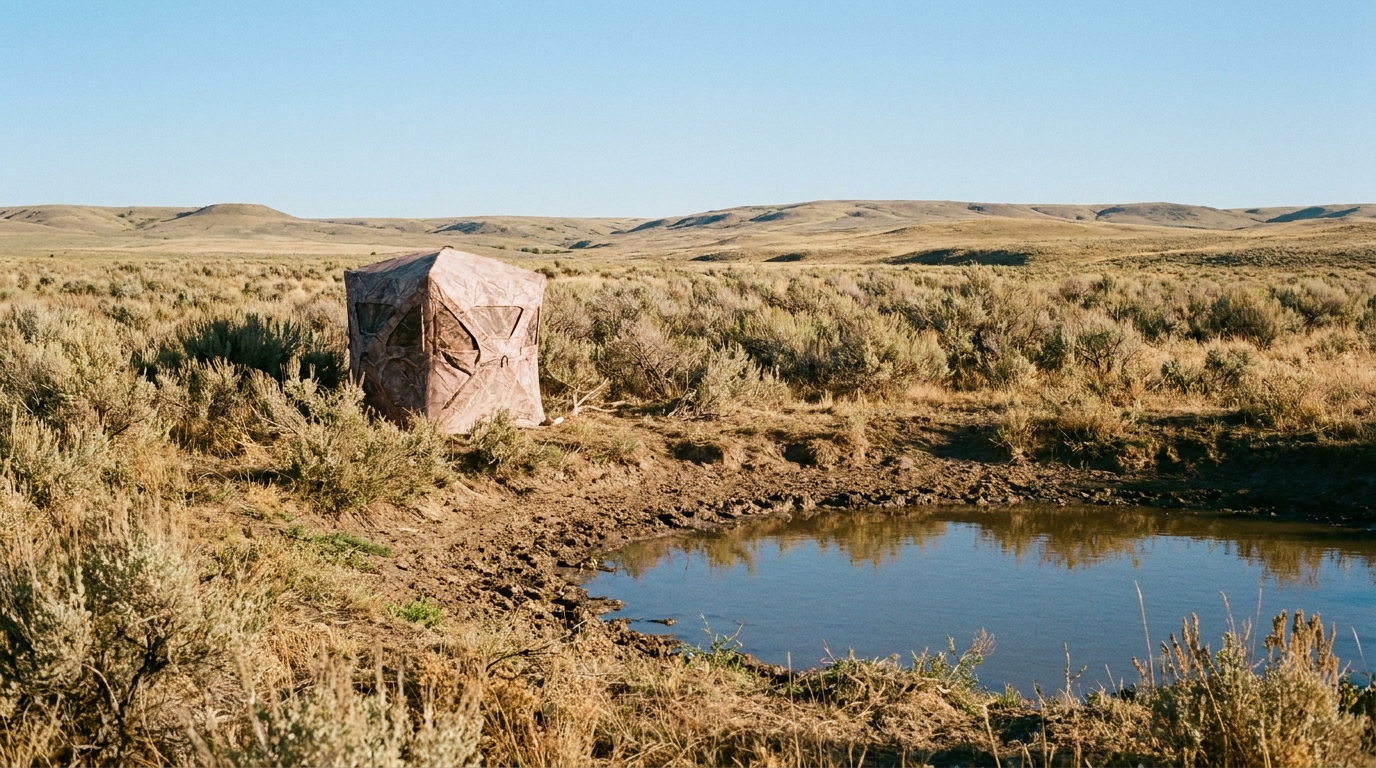
Pronghorn can go days without drinking when temperatures sit in the 60s and 70s. Push a western basin past 90 degrees in August, and that same animal is back at the tank every day, sometimes twice. That single behavioral shift is the entire reason water hole hunting works, and it's why a blind set up wrong at the right water source will still put you in bow range of pronghorn that a mile of stalking never would.
It's also a method a lot of hunters get half right. They find water, drop a blind on it the morning of the hunt, and wonder why animals hang up at 80 yards and never come in. The gap between a water hole sit that fills a tag and one that just burns a hot day in a plastic box comes down to a handful of details — most of them settled before you ever load a chair into the blind.
Finding water that's actually worth sitting
Not every wet spot on a map is a good ambush site. A big stock pond with three approach trails and grazing pressure scattered across a whole section will spread antelope thin and make patterning them close to impossible. What you want is a tight, obligate water source — a guzzler, a small tank, a spring box, a windmill pond — where the terrain funnels animals to one or two obvious drinking spots instead of a quarter-mile of open shoreline.
Scout before the season, not the morning you hang the blind. Glass the area from a distance for a day or two and watch which water gets used and when. A rangefinder-friendly spotting setup off a tripod, run from a knob a half-mile out, tells you more in two mornings than three days of driving section-line roads and hoping. If your current setup isn't up to holding steady glass on a water hole for an hour at a stretch, a stable binocular harness and a decent spotter off current optics deals will pay for itself the first sit — nothing wastes a scouting window like glass you can't hold still.
Old infrastructure helps more than it hurts. Antelope that have walked past a busted corral, a windmill frame, or a stock tank for years are far more tolerant of a new shape showing up near it than they are of a blind dropped in open sagebrush with nothing else around. Use that camouflage of familiarity if the site has it.
Blind placement: distance, sun, and patience
The single biggest mistake in water hole hunting is putting the blind right on top of the water. It feels efficient and it kills the hunt. Back off — 35 to 40 yards from where animals actually drink is a reasonable starting distance for a bow setup, with room to tighten that up over a few days once the blind has been sitting there a while.
Sun position matters as much as distance. Pronghorn work water hardest from mid-morning through mid-afternoon in hot weather, so set the blind with the sun at your back during that window. A blind facing into the glare all day is a blind that's hard to shoot from and easy for a sharp-eyed animal to pick apart.
Get the blind out early — a week ahead of your hunt if the tag and access allow it — and leave it exactly as you'll hunt it: windows open, any shoot-through mesh already hung. Antelope get used to a static shape fast, but they notice a blind that changes shape or suddenly grows new flaps and windows the day you show up in it. If you don't have that kind of lead time, at minimum give it 48 hours and expect the first sit or two to be more cautious animals working the edges rather than committing.
Wind still runs the whole operation. Pick the downwind side of the water for your entry and exit routes, not just your shooting position, and get into the blind in the dark before first light so you're not silhouetted walking in against a rising sun. A blind with perfect placement relative to water and sun still gets busted by a hunter who walks his scent line straight across the approach trail on the way in.
Scent discipline on a stationary sit
Spot-and-stalk hunters get one shot at a stalk and can often work around wind on the move. A water hole sit puts you in one spot for eight, ten, twelve hours, breathing and sweating in 90-degree heat while animals work directly toward your position. That's a different scent problem, and it's worth treating like one — scent-free laundry and body wash before the hunt, and for hunters serious about hammering down human odor in a blind, an active scent-control system run through the day cuts down what's drifting out through the windows far more than passive control alone. It's the same gear a lot of treestand and ground-blind whitetail hunters lean on, and the logic holds just as well parked over a stock tank in July as it does over a scrape in October.
What to bring for an all-day sit
Plan on the whole day, sunrise to sundown, especially once you're past the first couple of hot mornings and animals have started watering at odd hours to dodge hunting pressure. That means:
- A comfortable, low-profile chair — a folding camp chair that puts you below window height, not something that has you hunched
- More water than feels necessary; heat exhaustion inside a closed blind is a real risk, not a minor inconvenience
- Shade cloth or a reflective tarp over the blind roof if the site has zero natural shade
- A pack built for sitting gear plus a midday food break, not just a day hike — Forloh's current pack lineup is worth checking before the season if yours is built for moving light rather than carrying a chair, water, and optics to a fixed post
- Lightweight, breathable layers for a blind that turns into a greenhouse by 10 a.m. — this is where hot-weather base layers earn their keep over the heavier gear built for October stands
- A rangefinder and a pre-ranged mental map of the shooting lanes from your blind windows, marked before the first animal shows up, not while one is standing at 30 yards
Shot distance and practice
Water hole antelope don't always walk into your ideal 20-yard chip shot. Wary animals — especially bucks that have survived a season or two of hunting pressure — often hang up at the edge of their comfort zone and drink from there. Being genuinely proficient out to 40 yards, under the kind of pressure that comes with a live animal in the window rather than a foam target in the yard, is what turns those hang-up shots into filled tags instead of blown opportunities. If your practice sessions have been all 20-yard groups off a bag, water hole season is the wrong time to find out that changes at distance.
When to sit water instead of stalking
Water hole hunting is a tool for specific conditions, not a wholesale swap for spot-and-stalk pronghorn tactics. It shines during a heat spell, on pressured public ground where animals have gone nocturnal on their movement between bedding and feeding, or on terrain flat and open enough that a stalk is nearly impossible without spooking every animal in the section. If you've got cover, broken terrain, and animals still moving on a normal pattern, a stalk executed with a real plan still beats sitting a blind. Worth reading both approaches before the season and deciding case by case which fits the ground you've drawn.
The rut, which typically runs into September across much of pronghorn country, adds another layer — bucks cover ground chasing does and checking water more erratically, which can work for or against a stationary blind depending on how locked in a particular water source is for the local herd.
Regulations before you set up
Water hole hunting rules vary by state and sometimes by unit — some states restrict blind placement near water on public land, require blinds to be removed within a set number of days after the season, or have specific rules for hunting over water sources shared with livestock. Check your state's regulations before you build a setup you can't legally hunt, and don't assume the rules from last year's tag carry over to a new state or unit.
Get the water source right, get the blind in early, and manage wind and scent like the sit actually matters — because at 90 degrees in August, it's often the difference between a tag in your pocket and a long, hot day watching antelope drink from just out of range. For more on building out a glassing setup for the rest of a western season, the glassing system breakdown is worth a read, or head back to the Timberline home page for what's currently on sale.