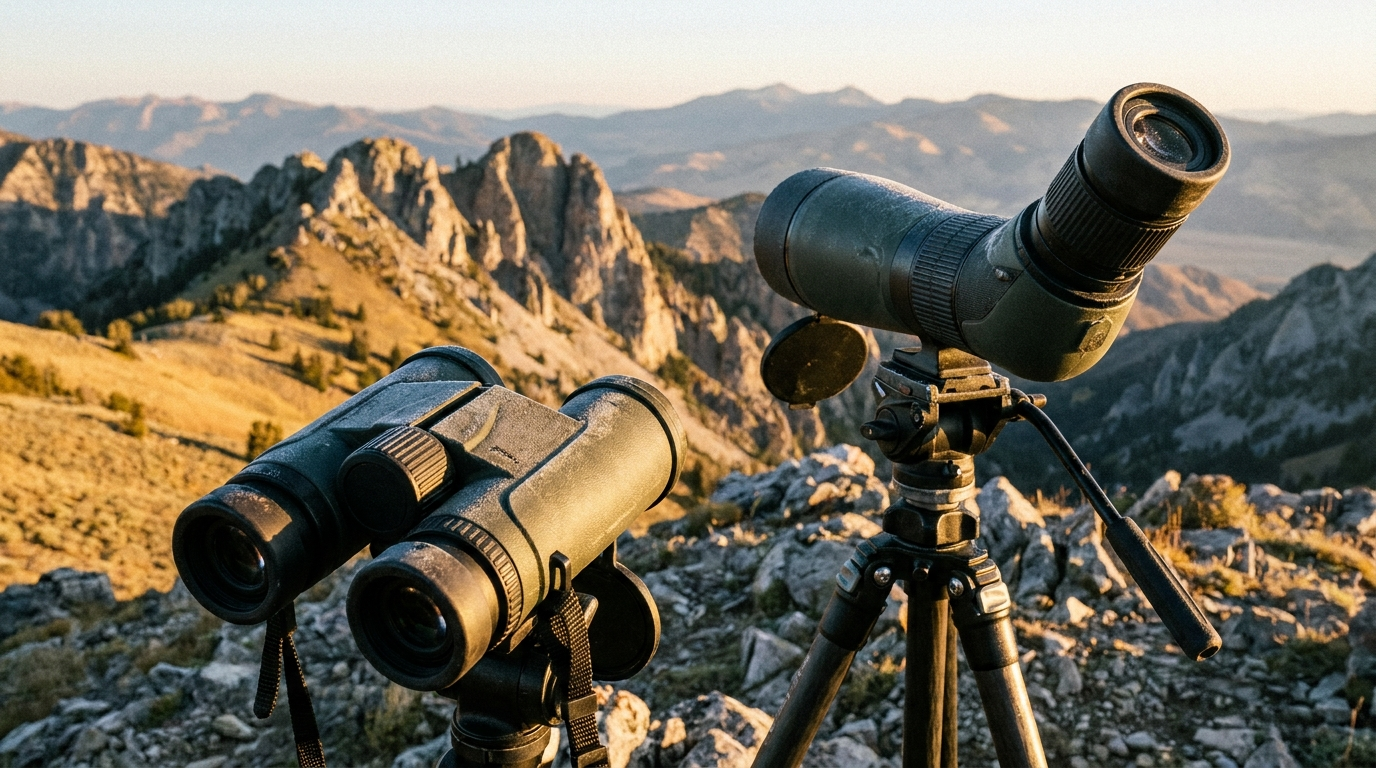
Most hunters who don't kill out west walk too much. They cover miles; experienced hunters cover country. The difference isn't fitness — it's patience with glass.
A solid glassing system — quality binos, a spotting scope, a steady tripod — can locate an animal at 800 yards that you'd have walked within 50 yards of and never seen. That matters on public land, where the animals that survive a few seasons have learned to hold tight in shadow and let careless hunters pass. A mature mule deer buck doesn't spook from boot traffic. He waits.
The first time you find a buck at 600 yards in his bed under a rimrock you'd never have hiked to — that's when western hunting clicks. You plan a stalk, take the long route around, come in from above an hour later. The whole sequence starts with glass.
This guide covers the gear, how to build a real glassing position, and the technique that separates hunters who find animals from those who spend a week looking at empty country.
Two Pieces, Two Jobs
Binoculars find animals. A spotting scope evaluates them.
Most hunters either skip the spotter entirely or use it for work their binos should handle first. The binos cover country broadly — when you're searching a 300-yard-wide bowl or a canyon face, you need field of view and speed. Once you've found something (a leg, a patch of tan, a dark horizontal line under a juniper), the spotter zooms in to figure out what it is and whether it's worth the stalk.
Trying to find deer through a spotting scope set at 45x is slow and exhausting. The field of view is tiny — you're looking at a postage stamp of hillside at a time. The difference shows up in coverage: hunters who show up with only a spotter cover roughly a third the country per hour compared to a bino-first system. Use the binos to find, and the spotter to decide.
Picking Your Binocular Magnification
The 10x42 is the default western bino for a good reason — versatile enough to use handheld while moving and effective enough on a tripod for stationary glassing. If your style leans toward sit-and-glass from vantage points, a 10x50 or 12x50 pulls in more light and shows a sharper image at twilight and in shade. The Vortex Razor UHD 10x50 shows up in the current optics deals at real discounts, and the UHD glass is a step up from the previous Razor HD generation in the edges and in low light where it counts.
For big, open country — Wyoming Basin pronghorn, Nevada desert basin mule deer, sheep country above treeline — the Vortex Razor UHD 18x56 is worth considering — another one that turns up marked down in the optics listings. At 18x you're tied to a tripod, no question, but in flat open terrain you're essentially hunting with a compact spotting scope in your hands. That trades favorably against carrying both a 10x bino and a separate spotter.
For elk in timber and mixed cover, 10x is the better choice. The wider field of view picks up movement in broken timber that a 15x or 18x bino misses.
The Spotting Scope
An 80mm or 85mm spotter in a 20-60x zoom range is the standard for western big game. Beyond 85mm the weight adds up too fast in a pack. The high end of most zooms — 60x — is rarely usable in heat shimmer anyway. Most hunters spend their time at 30 to 45x.
The Vortex Razor HD 27-60x85 angled is the one to watch for on Outdoorsmans' deal listings. The angled body wins over straight for stationary glassing — you set the tripod at a comfortable height and look down at the eyepiece rather than cranking your neck straight through it. On a long ridge-glassing session, that ergonomic difference adds up over two hours.
If a flagship spotter is more than you want to spend, the Vortex Viper HD 20-60x85 angled is a legitimate option at a fraction of the price, and it shows up discounted in the current optics deals. The image gets softer above 40x, but at 30x it's clear enough to judge antlers and worth the savings if you're also building out the rest of your kit this season.
The Tripod Is Not Optional
A lot of hunters buy good binos and then rest them on a pack or press them against a tree to steady up. That works at 200 yards. At 600 yards you're missing a third of the animals that are there, because your image is not stable enough to catch subtle details — the edge of a tine against gray brush, the slightly darker rectangle of a bedded deer's body against a hillside shadow.
A bino adapter and tripod change what you can see. A 10x42 held rock-steady on a tripod effectively shows you what a handheld 15x would, because the image resolves fully when it isn't bouncing with your pulse.
You don't need to spend $400 on a tripod for binoculars. A fluid head or solid ball head in the $150 range on a $100 travel tripod handles most western hunting applications. A cheap tripod with a friction head that slowly drifts will frustrate you in the field because the image slides away whenever you let go. Buy once.
Most experienced western hunters run one tripod for everything — binos and spotting scope both through the same Arca-Swiss ball head. Get your system set up and dialed before the season, not on opening morning in the dark.
How to Set Up a Glassing Station
A glassing station is a deliberate position, not where you happened to stop. It needs four things: visibility, shade, stable ground, and physical comfort.
Visibility means a vantage point that looks across country rather than up a slope. You want to see the bottoms of drainages, north-facing aspects, the edge of timber from a position that doesn't require cranking your neck up. A spot that takes 45 minutes to hike to but shows you three drainages and a canyon face is worth more than a closer position that shows one slope.
Shade matters more than most hunters realize. Glassing from a lit position into shade is harder than the reverse — your eyes constantly adjust to bright surroundings and you lose detail in the dark areas where animals hide. Get into shadow when you can. As a side benefit, you're much harder to spot when you're not a moving silhouette on a skyline ridge.
Stable ground means spending a few minutes leveling your tripod on rock or soil. Ten minutes on loose scree where the tripod constantly shifts is maddening.
Comfort is the factor most hunters underestimate. You cannot glass thoroughly for 90 minutes if your back hurts after 20. An ultralight foam pad, a small camp chair, a stuff sack under your sit bones — whatever keeps you still. The hunters who find animals are the ones who stay put.
The Grid and Why Speed Kills
New glassers move too fast. They scan a hillside in three minutes, see nothing obvious, and move on. A patient glasser might spend 45 minutes on that same hillside and find two deer in beds that were invisible at scanning speed.
The grid is simple enough: pick two landmarks (a rock, a tree edge) that define a vertical strip. Glass everything in that strip from bottom to top. Move one strip-width over and repeat until you've covered the whole face.
The hard part is keeping your place. Use natural boundaries when they exist — a rimrock across the canyon, a drainage below, the timber edge above. When those don't exist, pause at each strip transition to fix a physical landmark before moving on.
Glass at roughly half the speed that feels natural. Whatever pace seems thorough to you probably isn't. Pause every few sweeps to examine shadows and edges closely. Most bedded mule deer are invisible on a fast pass. They show up as subtle details: a horizontal line where the terrain shouldn't have one; a patch of tan that's slightly too uniform for the surrounding rock; one ear twitching on an otherwise still hillside.
At first and last light, search meadows and feeding areas for movement. Midday, shift focus to shaded north-facing slopes, juniper pockets, and the shadowed base of rimrock. The terrain where deer will be changes over the course of the day, and your search pattern should change with it.
You're not looking for a whole deer. Your eye finds a full deer standing in a meadow without any system — that's easy. You're looking for parts: a tine catching light against gray rock, a patch of color that's slightly too uniform for the brush around it, one ear twitching on a hillside that's otherwise still.
A Note on Species
For mule deer, prioritize north-facing slopes and shade once temperatures climb above 70°F. A mature buck finds the coolest dark spot on the mountain and stays there from mid-morning until late afternoon. South-facing draws and open flats in midday sun are worth a quick look, but don't burn your prime sitting time there.
Elk follow thermal patterns more predictably than deer. Cool morning air drains downhill, and elk feed toward the upper edges of meadows in the morning. Evening thermals reverse — warm air rises — and elk move lower. In broken timber country you'll often hear them before you see them. A bugling bull at 500 yards in dark timber is worth sitting very still and watching the edges.
Where to Find Current Deals
The Vortex Razor UHD bino and spotting scope deals at Outdoorsmans and Alaska Guide Creations are about as strong as optics pricing gets outside of closeout sales. Check the full deals page for current pricing — optics inventory moves, and the discounts on Razor HD and Razor UHD glass change as stock turns.