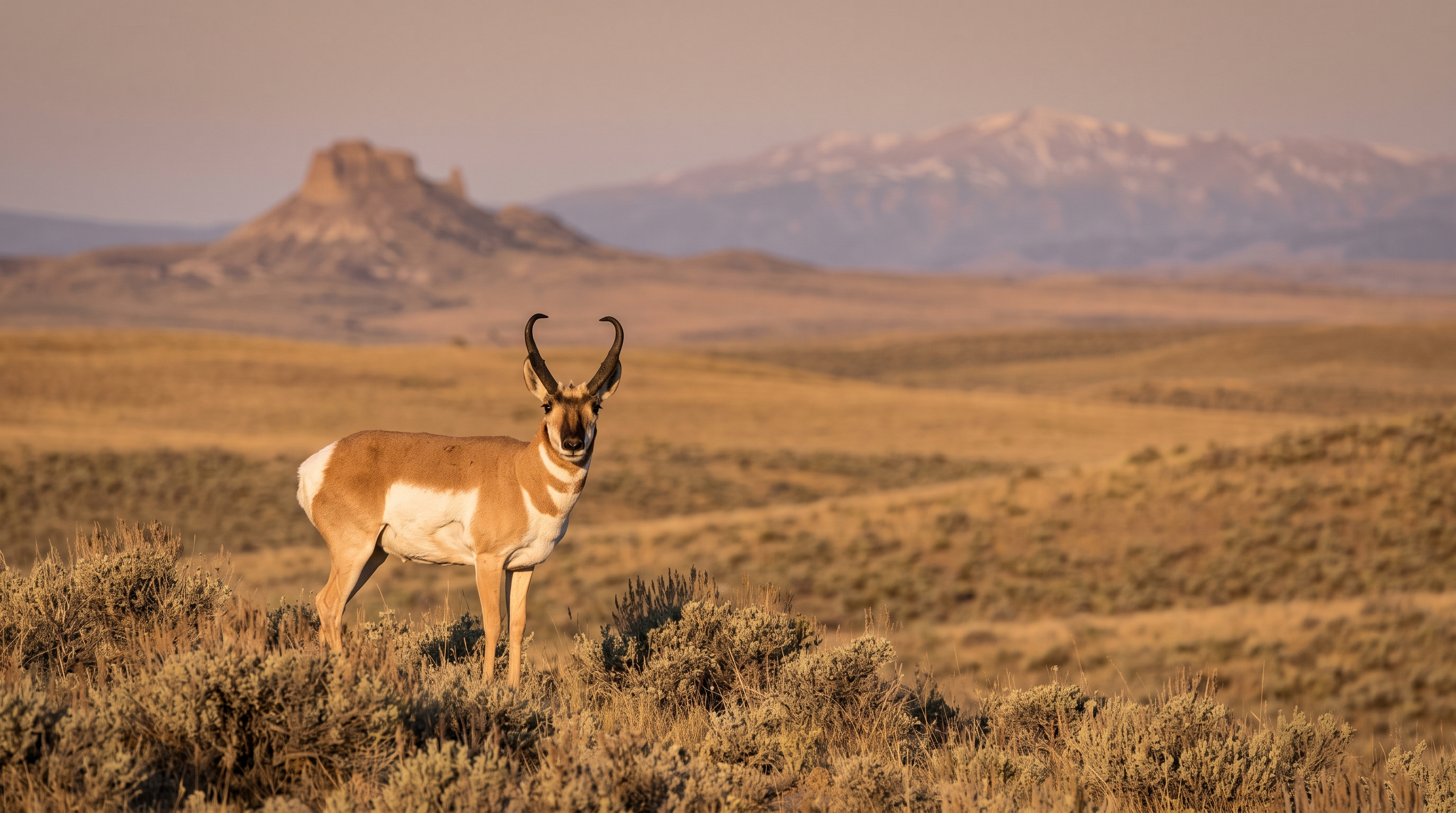
Pronghorn have the largest eyes relative to body size of any North American ungulate. Their visual field runs close to 300 degrees. At distance, they pick out movement the way you would pick out a neon sign. You know this before your first hunt. You really understand it about ten minutes into your first failed stalk, watching a buck that was 500 yards away decide you're a problem and disappear over the ridge at a pace that seems physically impossible.
Every elk or deer hunting instinct you carry into antelope country will get you burned. The game is different here, and the sooner you accept that, the sooner you start closing distance on bucks.
Wyoming First, Everything Else Second
If this is your first DIY pronghorn hunt, Wyoming is where you start. The state holds more antelope than it has human residents — roughly 480,000 animals across sagebrush plains that run for hours in any direction you care to drive. Draw odds for most units sit around 50-70%, OTC archery tags give you an option if you want to skip the draw lottery entirely, and public BLM ground is plentiful. Harvest success for rifle hunters runs above 85% most years. That's not the rate for guided hunts — that's the general tag.
Montana is the runner-up. Eastern MT has pronghorn country that stretches to the horizon with less competition than Wyoming. Draw only, but odds are moderate and the country is worth the effort.
Colorado offers OTC archery tags. Nevada and Arizona are effectively trophy programs for people with 15+ accumulated preference points. If you want to learn how to hunt antelope and put meat in the freezer, get your Wyoming application in before the late-April deadline. The learning curve on pronghorn is steep enough without waiting a decade for a tag.
Glass More Than You Walk
The core loop of a pronghorn hunt: find a rise with sight lines, set up a quality tripod, glass until you locate a buck worth chasing. Then spend the next two to four hours trying to close within shooting range without being detected.
This is why optics matter more on pronghorn than on anything else in the western hunting catalog. The difference between 8x42 binoculars and top-end 10x50s is not subtle when you're reading a buck at 600 yards in flat afternoon light. You need to distinguish mass from tine length, assess prong size, read that rear curve — all on an animal that is likely partially screened by sage and possibly facing away from you. Inferior glass turns field judgment into gambling.
The Vortex Razor UHD 10x50 shows up in the current optics deals regularly, and the 12x50 version runs alongside it. For pronghorn, the 10x is the better pick: enough power for open terrain, and the 50mm objective gathers more light in the early morning hours when bucks are on their feet. Vortex glass in this tier is exceptional. The Razor UHD is among the best production binos available at any price, and when it's on the board it runs well below retail.
A spotting scope earns its pack weight once you're glassing past 400 yards consistently. The jump from "that looks like a decent buck" to "that buck is worth a four-hour stalk" requires 30-40x to read tine length and mass. The Vortex Razor HD 27-60x85 spotting scope runs well below retail through Outdoorsmans when it's in stock. The Viper HD 20-60x85 is the more practical option if you're hunting pronghorn a few times a season rather than making it your primary obsession.
One thing to add to the optics kit: a good binocular harness keeps glass on your chest and accessible all day, not stuffed in a bag. Alaska Guide Creations makes harness systems that actually hold up in the field, and harness bundles turn up in the accessories deals regularly.
When to Commit to a Stalk — and When to Wait
Most failed pronghorn stalks fail before they begin. The mistake: approaching a buck that's feeding in flat, open ground with no useful cover between you. You walk toward it. It pins you at 600 yards. Now it has watched you for ten minutes and won't let you back inside 400 for the rest of the afternoon.
Wait. Let the buck move.
Pronghorn travel constantly — feeding, checking does, shifting to bedding ground, patrolling territory. A buck that's sitting in the open right now may walk into a draw in an hour that gives you cover to close 400 yards undetected. Hunters who consistently kill antelope are patient glassers. They watch animals for hours before committing to a stalk rather than blundering in and burning the opportunity. Rushing is the single most common mistake on a first hunt, and it is extremely common.
Terrain features that give you a chance: dry creek bottoms and washes, shallow draws, rolling sagebrush ridges that break your outline, fence lines with grass cover along them. Wyoming and Montana flats that look completely featureless from the road frequently have subtle topography — two-foot drops, low sage thickets — that drops you below a pronghorn's sightline if you stay low and move deliberately. Expect to spend serious time on your elbows. The belly-crawl earns its reputation.
Wind matters but is secondary to movement. Pronghorn rely on vision first. What kills stalks most often is movement while the buck is watching your direction. The rhythm: move when it feeds, stop when it raises its head, wait it out. That is most of the job.
Shot Distance and the Rut
Most pronghorn fall between 150 and 300 yards. Plan your shooting to 400 before you leave home, because some opportunities don't present closer and a week of tags goes fast.
First-time hunters sometimes hold out for a picture-perfect 150-yard setup and go home empty-handed. If a mature buck is standing still at 270 yards in good conditions and you have a solid rest, that is a high-percentage shot — take it. Pronghorn hunting has a way of recalibrating your expectations as the week goes on.
A good rifle scope matters as much as caliber here. The Leupold Mark 5HD 7-35x56 turns up at serious money off retail — usually as a pre-owned unit through Outdoorsmans, which is how the price gets there. For a premium optic that handles both close-range encounters and longer shots, that margin is significant.
During the rut — late September in most of Wyoming and Montana — calling works. Pronghorn bucks get territorial when does are cycling. A decoy paired with a chuckle call or buck snort will pull bucks from distances that seem too far to work. The window is short, maybe three to four days at peak, depending on your area and the weather. If you're hunting the last two weeks of September, pack a decoy.
Cool the Meat Same Day
September pronghorn seasons run hot. Temperatures above 80°F are common in Wyoming during early rifle. Pronghorn have a higher natural body temperature than deer or elk, which means the meat spoils faster than you would expect if you've spent most of your time on late-season whitetails where cold ambient temperatures do most of the cooling work.
Field dress immediately after the shot. Quarter and bag within an hour of the kill. Not two hours — one. Keep all hair off the meat; even small amounts cause off-flavor, and pronghorn has enough of a distinctive taste without adding gaminess from hair contact. Use breathable cloth bags and get quarters on ice same day.
A capable pack carries more weight here than most hunters expect, especially if you're in country that requires a real pack-out. The Forloh Method 4400 routinely shows one of the deepest markdowns in the pack deals — a legitimate backcountry-capable pack that is hard to pass on when it's running at a fraction of retail.
What It Takes
Pronghorn hunting is harder than it reads on paper. The animal has vision that borders on unfair, and the terrain strips away almost every advantage cover normally provides.
Most hunters burn several stalks before their first kill. That's how the learning works. Go in expecting to fail before you succeed, and when the right buck walks into the right draw on day four, you will know exactly what to do.
For current deals on western hunting optics, packs, and gear, see what's on sale now at Timberline Deals.