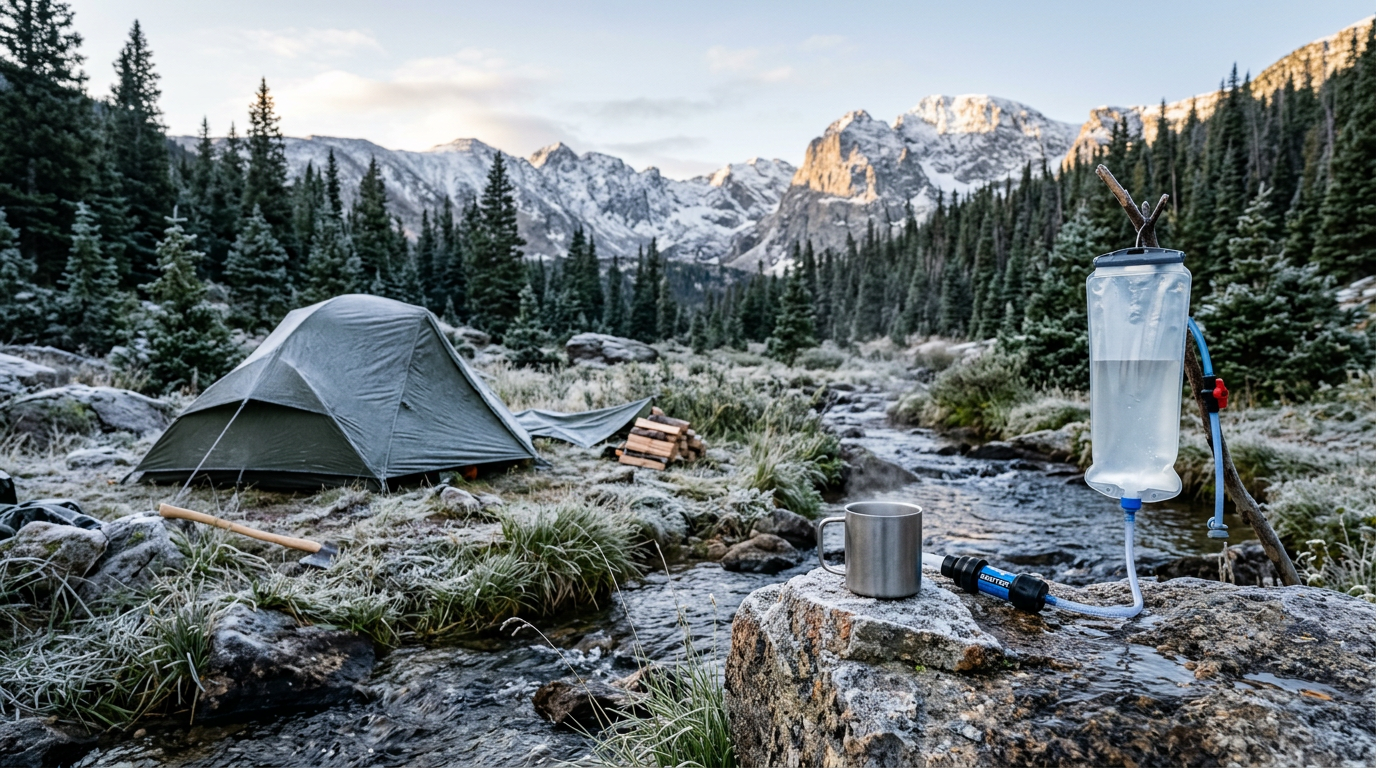
Camp temperature dropped into the low twenties overnight at a 9,400-foot elk camp in September, and the squeeze filter left outside the tent did exactly what it always does the next morning: it passed water. Clear, cold, tasting like nothing. What it wasn't necessarily doing anymore was filtering anything at all.
Hollow-fiber filters — the Sawyer Squeeze and everything built on the same technology — work by forcing water through thousands of fibers with pores rated around 0.1 microns, tight enough to strain out giardia and cryptosporidium, which need a filter rated at 1 micron or tighter to get caught. That's the whole mechanism. It's also the whole vulnerability. When those wet fibers freeze, the water inside them expands and creates microtears too small to see and too small to notice in normal use. The filter still passes water at a normal rate. It just no longer reliably stops the organisms it's supposed to stop, and there's no visual or functional way to tell from the outside. Sawyer's own position is blunt about it: they don't have proof a freeze always ruins the filter, but they don't have proof it doesn't, so their guidance is to replace any filter you suspect took a hard freeze. That's not a company being cautious for legal cover. That's an honest admission that the failure mode is invisible.
Why a single method isn't enough at altitude
Most gear write-ups treat water treatment as a one-and-done gear choice: buy a filter, done, checked off the list. That's fine at a car-camping trailhead in July. It falls apart on a September or October elk hunt above 8,000 feet, where overnight lows regularly sit below freezing even while daytime highs are pushing hunters into short sleeves, and where a single piece of gear failing silently is a real problem four miles from the truck.
The three treatment methods available handle that environment differently, and none of them is a complete answer alone.
Mechanical filtration (Sawyer Squeeze, Katadyn BeFree, similar hollow-fiber designs) is fast, requires no wait time, and handles the turbid, sediment-heavy water common in elk country — runoff, beaver ponds, stock tanks. Its weakness is the freeze issue above, plus the fact that hollow-fiber filters generally don't stop viruses, which matters less in North American backcountry water but isn't nothing.
UV treatment (SteriPEN and similar pens) kills everything, including viruses, in about 90 seconds — but only in clear water. UV light needs to penetrate the sample to work, and independent testing has never established reliable performance in the murky water elk hunters actually draw from. Pair a UV pen with a pre-filter and it works. Used alone against a silty seep, it's close to useless, and there's no way to tell it failed except getting sick three days later.
Chemical treatment (chlorine dioxide drops like Aquamira, or tablets like Katadyn's Micropur) is the lightest option in a pack and the only one that's essentially freeze-proof — a bottle of drops that froze and thawed works exactly the same as one that didn't. The catch most hunters skip past: chlorine dioxide kills giardia in about 30 minutes, but cryptosporidium takes a full four hours of contact time. Most guys treating water with drops wait the 30 minutes, call it good, and drink. That protects against giardia. It does roughly nothing extra against crypto beyond what the untreated water already had going for it, because four hours is longer than most hunters are willing to sit around thirsty.
That's the actual contrarian point here: the "I treated my water" claim that gets repeated on every gear forum is frequently only half true. Giardia, yes. Crypto, only if the four-hour wait actually happened — and in practice, it rarely does.
The redundant system, built out in ounces and dollars
The fix isn't picking the "best" method. It's carrying two that fail in different ways, so a freeze that kills the filter doesn't leave a hunter with nothing, and a murky seep that beats the UV pen doesn't either. Here's a system built for a five-day solo elk camp, priced at realistic retail rather than any single sale:
- Hollow-fiber squeeze filter: about 3 oz, roughly $35-$45
- Chlorine dioxide drops (two-part kit, enough for the full trip): about 2 oz, roughly $14-$20
- 2-3 liter collapsible reservoir plus one 1-liter soft bottle for dirty-water collection: about 5 oz combined, roughly $25-$40
- Total system weight: 10 ounces
- Total system cost: $75-$105
Compare that to a UV pen carried alone at $80-$100 with zero backup when its batteries die in cold weather — a common failure at altitude, since lithium batteries lose voltage fast below freezing — and the two-method redundant setup wins on weight, cost, and failure coverage at the same time. That almost never happens in gear comparisons; usually redundancy costs you ounces. Here it doesn't, because chemical drops are so light that adding them barely registers on a scale.
How much water actually gets used
The daily number matters as much as the treatment method, because it decides how many refill stops a hunt actually needs. Baseline hiking hydration recommendations run 2-3 liters a day. Above 8,000 feet, increased respiration rate and lower humidity push real-world needs higher — hunters covering ground hard during September elk season report averaging closer to 5-6 liters a day once coffee and rehydrated meals are counted in, and a genuinely hard day of climbing after bugles can push that past 6.
Run that against a 3-liter reservoir and the math is simple: a hard hunting day means two to three full refills, which means the treatment method has to work fast and work reliably every single time, not just on the first cup of the morning.
Field habits that actually prevent the failure
Two habits fix most of this without adding weight:
Sleep with the filter. On any night where camp temperature is forecast anywhere near freezing, the filter goes in a dry bag inside the sleeping bag, not in the vestibule. It's a five-second habit that removes the entire freeze-failure question.
Test a filter you suspect froze before trusting it again. Saturate it with water, cap the dirty-side inlet, and blow firmly through the clean-side outlet while the inlet stays submerged. Bubbles forming easily mean the membrane has torn and the filter needs to be retired — not patched, not "probably fine," retired.
Neither of those costs money. The chemical backup does, and at $15-$20 for a full trip's worth of drops, it's one of the cheapest insurance policies in a pack built around a current pack deals budget that's already stretched thin by boots, optics, and a rifle or bow. Forloh's discounted Method pack bodies carry a bladder and the treatment kit without adding a second compartment problem, which is worth checking before the trip if the current pack setup is already maxed on volume.
None of this is a reason to skip a filter — mechanical filtration is still the fastest, most practical daily-use method for the water elk hunters actually find. It's a reason to stop treating it as the only method. The camp that freezes hardest is usually the same camp with the least margin for a water-borne illness costing a hunter two days of a five-day season. A current shelter and camp gear selection that keeps a filter warmer overnight solves part of the problem before it starts; the drops solve the rest.
Check the current accessories deals for filters and treatment kits before the season starts, not after a scouting trip turns into a lesson. The pre-season pack shakedown is the right time to weigh this system in with everything else, and the western hunting pack guide covers where it fits once volume gets tight. Everything else on the site runs the same deep discounts this system does — worth a look while gear is still getting sorted for September.