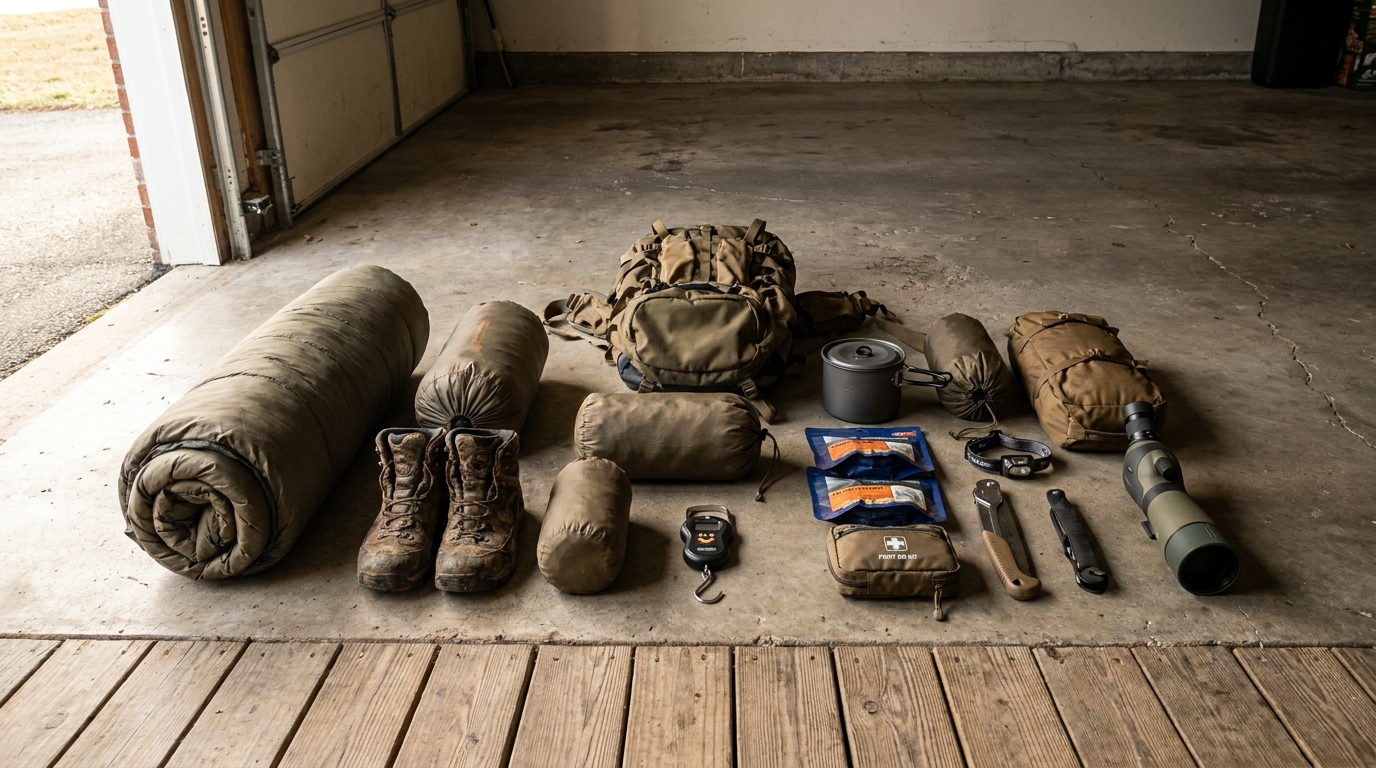
A postal scale on the garage floor, twenty-some gear piles sorted by category, and a Saturday morning in early August: that's what a real pack shakedown looks like, and it's the only way to know what a loadout actually weighs instead of what you assume it weighs. Most hunters build a gear list once, maybe in March, and never touch it again until they're stuffing it into a duffel the night before they leave for the trailhead. By then it's too late to cut anything.
Here's the stance this piece is going to take, and it cuts against most of the ultralight advice floating around hunting forums right now: obsessing over the last four ounces in your base weight is mostly wasted effort for a backcountry hunter. The number that actually decides whether your September hunt goes well isn't your base weight. It's whether your pack, your body, and your plan can handle carrying an animal out. Shave grams all you want on stuff sacks and titanium stakes — if your frame is rated for 65 pounds and you need to move 90 pounds of boned-out elk quarters off a mountain, the ounce-counting never mattered.
What actually needs to go on the scale
Start with the Big Three, because that's where real weight lives: the pack itself, the sleep system, and the shelter. Backcountry hunters comparing notes on forums like Rokslide keep landing on the same rough split — a sub-20-pound base weight (pack, sleep system, and shelter, no food or water) for anyone running a lean multi-day setup, with 10 to 15 pounds added on top for hunting-specific gear like optics, weapon, and tags. Exo Mountain Gear has published complete gear lists from guides like Mark Huelsing running an 18-pound base weight for backpack elk hunts, which gives you a real number to shakedown against instead of a guess.
Weigh the pack empty first. Anything over 5 pounds for an empty hunting pack is carrying more structure than most solo backcountry setups need — that's 5 pounds gone before a single ounce of gear goes in. Forloh's Method 4400 pack body is worth putting on the scale against whatever you're currently running; it's one of the frames actually built around this category's real load-hauling requirements rather than borrowed from three-season backpacking, and it's part of the current pack deals on the site right now.
Sleep system next. Older 0-to-20-degree bags commonly run 4 to 8 pounds. Current-generation bags covering the same temperature rating can come in under 2.5 pounds, some closer to a pound and a half. That's a 4-to-6-pound swing sitting in a single stuff sack, which is a bigger single cut than every "gram weenie" trick in the rest of the list combined. If your bag is more than five seasons old, it's the first thing to weigh.
Shelter is the third leg. A four-person backpacking tent like Big Agnes's Wyoming Trail 4 tells you something worth knowing before you shakedown your own shelter: know the packed weight of what you're actually carrying, not the number on the box from when it shipped without stakes, footprint, and a stuff sack that's been swapped for a heavier aftermarket one somewhere along the way.
The shakedown math, category by category
Run the actual audit like this. Weigh every piece on a kitchen or postal scale, sorted into stacks: shelter, sleep system, cook system, clothing you're carrying but not wearing, safety and repair items, and consumables. Write down every number in ounces — pounds hide the small stuff.
A realistic target for the non-consumable base: 12 to 14 ounces for a lean one-person shelter system, 24 to 40 ounces for a sleep system depending on temperature rating and your own cold tolerance, 8 to 12 ounces for a minimal cook kit (canister stove, single pot, lighter, no stove-top coffee setup), and 16 to 24 ounces for safety and repair — headlamp, first aid, fire kit, cordage, a compact repair kit for boots and pack. That stacks to roughly 60 to 90 ounces, or 4 to 6 pounds, before the pack itself and before anything hunting-specific goes in.
Add the pack (aim under 5 pounds empty), your weapon and optics (a rifle and rangefinder or a bow with a release and rangefinder typically run 8 to 12 pounds combined with a basic binocular), and your clothing layer for camp. That's where most lists land in the 18-to-22-pound base weight range that backcountry forums treat as the honest target for a multi-day solo hunt.
Then add water and food, and the real number shows up. Three liters of water alone weighs about 6.6 pounds. Food typically runs close to 2 pounds a day per hunter. Run that out over a five-day hunt and you're carrying 10 pounds of food on top of whatever water you're not resupplying from a spring or creek. That's how a careful 20-pound base weight turns into a 45-to-65-pound pack walking in — and why solo elk hunters commonly report landing somewhere in that range once everything's loaded, weapon included.
Where the ounces actually matter
None of this means ignore small weight. It means put it in the right order. Stuff sacks are the classic trap: four separate 3-ounce sacks for sleeping bag, clothing, food, and electronics adds up to nearly a full pound of pure organization with no other function. Consolidate into fewer, larger sacks or use compression bags that double as pillow stuffing, and that pound is gone without giving up anything you'd actually use.
Boots are the other place where small numbers compound in a way gear on your back doesn't. Weight carried below the ankle costs more energy per pound than weight carried in a pack — commonly cited backpacking research puts the ratio at something like four to six times the metabolic cost, though the exact multiplier varies by study and terrain. Trimming 4 ounces per boot is 8 ounces total, multiplied across tens of thousands of steps on a multi-day hunt. If your current boots are heavier than they need to be for the terrain you're actually hunting, that's a better use of shakedown energy than shaving a tent stake.
Field-strip anything with retail packaging before it goes in the pack — cardboard backing on freeze-dried meals, extra zip-tie packaging on batteries, the plastic clamshell around a headlamp. None of it does anything for you at 9,000 feet, and it adds up in both weight and noise.
The part the ultralight crowd skips
Here's where the shakedown conversation usually stops, and where it should really start for anyone hunting elk, mule deer, or bigger: what happens after the shot. A solo hunter who trims a careful 3 pounds off base weight but hasn't checked whether their pack frame and suspension can actually carry a loaded meat haul is optimizing the wrong variable. An empty pack rated to comfortably carry 60 pounds is a liability on a hunt where the realistic ask, post-kill, is 80 to 100+ pounds moved off the mountain in multiple trips.
That's the actual shakedown question worth asking before September: not "how light can this go," but "what's the heaviest load this frame, these boots, and this body can move, and does my plan account for that number." A pack system built for real load-hauling earns its keep on the walk out, not the walk in — frames rated well past casual backpacking weights are worth comparing before the season starts.
Boots that are broken in and rated for the terrain matter here too; a mountain boot that's fine empty-handed can feel very different under a loaded pack an hour into a pack-out. If that shakedown hasn't happened yet this summer, mountain boots on sale now and base layer options are worth checking against whatever's already in the closet, along with insulated layers for camp that pack smaller than they used to.
Run the scale test this month, not the week before the season opens. Pair it with the full checklist in the pre-season gear audit, and if the sleep system numbers above surprised you, the deeper breakdown in the backcountry sleep system guide covers bag, pad, and quilt tradeoffs in more depth. Then go check what's actually on sale before you buy anything to replace what the scale told you to cut.