Seventy-eight degrees at 8 a.m., climbing into the mid-80s by noon. That's not a heat wave for a lot of September archery country. That's Tuesday.
Most early-season elk content is written for the hunt hunters wish they were on: cool mornings, bulls screaming off the roost, a bugle-and-run stalk straight out of a hunting show. The hunt a lot of guys actually draw looks nothing like that. Opening week across Colorado, Idaho, and Montana regularly sits in the 70s and 80s through the first ten days of September, and that single variable changes almost everything about how a bull behaves. Research tracking bugling frequency has found activity starts dropping once temperatures climb into the 70s and keeps falling through the 80s. Elk are built to run hot already, wearing a coat meant for a Montana winter, and heat makes them lethargic. They shift onto a schedule built around avoiding the sun: bed down before first light, stay tucked in dark timber through the heat of the day, and don't move much again until well after dark. A bull that isn't moving isn't bugling, and a bull that isn't bugling isn't coming to a call.
That's the part most early-season advice skips. The standard playbook, cover ground, bugle at likely pockets, run to any response, assumes vocal bulls. Above roughly 75 degrees, that assumption breaks down for hours at a stretch, sometimes for most of a day. Calling into quiet timber during a hot stretch doesn't fail because your sequence was wrong. It fails because there was no bull close enough, awake enough, or worked up enough to answer, no matter how good the sequence was.
Why the wallow still works when the bugle doesn't
Here's the piece that carries through the heat: elk still need water every single day, and bulls in rut still wallow, hot stretch or not. A wallow isn't just a drink. Bulls roll in the mud to cool their core temperature, and they cake themselves in mud and urine as a scent display for cows and a threat display for other bulls. That behavior doesn't shut off when the thermometer climbs. If anything, a wallow gets more attractive to a hot, worked-up bull on a warm afternoon than it does on a cool one.
Wallow activity tends to cluster in two windows: a few hours after first light, and again in the couple of hours before dark, with a secondary bump around midday when the wallow sits close to heavy bedding timber. That gives a bowhunter a defined ambush window instead of an all-day guessing game. It also means you can plan around the heat rather than fight it. Skip the midday death march through dark timber looking for a bull that isn't moving. Sit the wallow instead, and let the heat do the work of pushing him to you.
Individual bulls don't always follow the script. Hunters have killed bulls at 4 p.m. in 70- to 80-degree heat, and there are accounts of bulls bugling on the hour through an 85-degree afternoon from a shaded drainage. Those are the exceptions, not something to plan a hunt around. Weather transitions matter more than any single number: a few hot days followed by a real cool-down, even ten or fifteen degrees overnight, will often get bulls fired up fast. Build the week around the wallow, and treat a cold front as your cue to switch back to calling.
Finding the wallow before the season opens
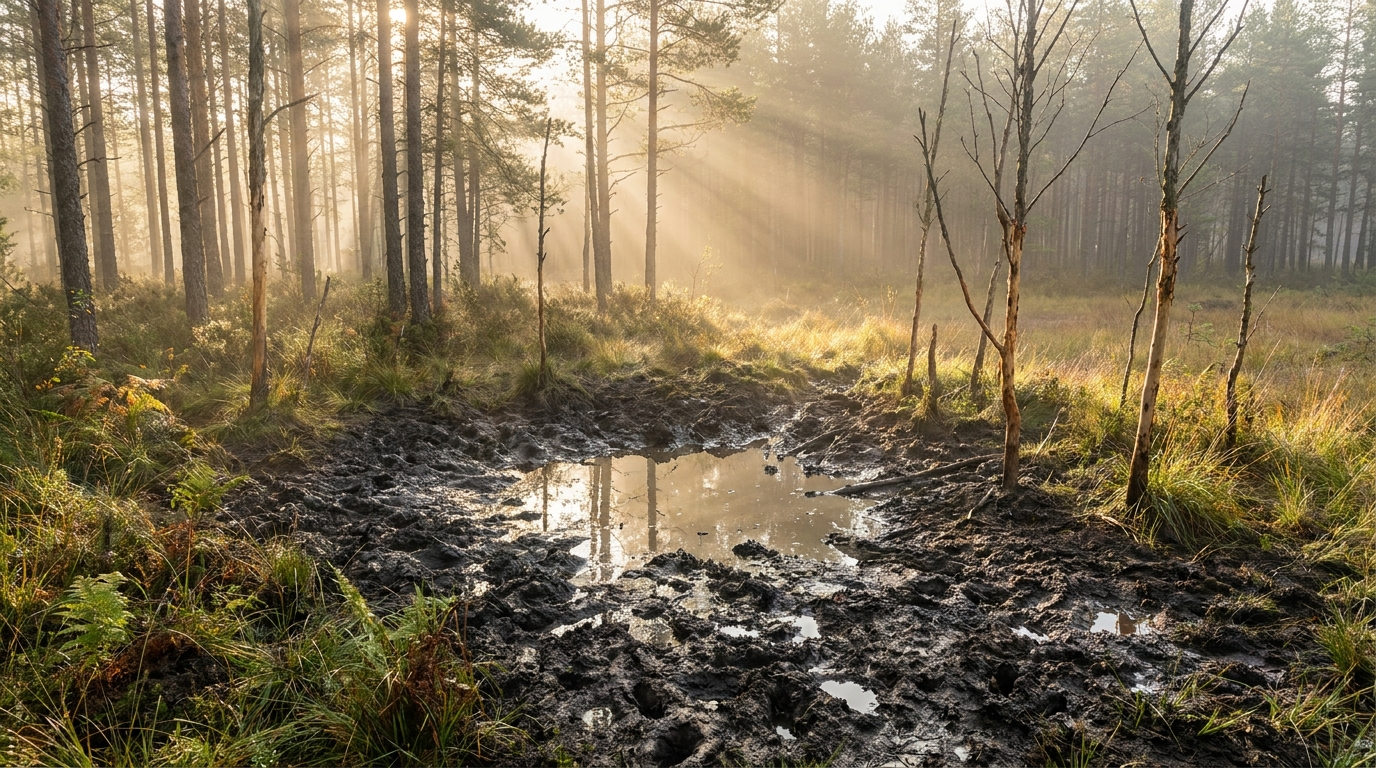
A wallow won't show up on a topo map, but the terrain that holds one will. Look for wet meadows, seeps, springs, and small green benches tucked into otherwise dry country, especially where a stand of dark timber sits within a few hundred yards. Aerial imagery from an e-scouting platform will show the green long before you set boots on the ground, and July is exactly the window to run that search from a couch instead of burning hunt days on it in August. Once you're in the unit, a working wallow is unmistakable: a churned mud pit, often ringed by rubbed saplings and torn-up ground, with a smell somewhere between a barnyard and standing water that carries a surprising distance downwind. Fresh tracks and wet mud on the rim mean current use. Cracked, dried mud means you found last year's wallow, not this year's.
A five-day plan for a hot opener
Here's how that plays out across a realistic opening week, one where the forecast runs warm early and breaks midweek.
Day 1 (high near 78): Glass from a distant ridge at first light with a spotting scope, watching known wallow benches and water for movement without pushing into the timber. Confirm the wallow is active, note the wind, and back out well before the heat sets in. Rest through the midday heat rather than hiking through it.
Day 2 (high near 82): Move into position downwind of the wallow by early afternoon, well ahead of the two-to-four-hour window before dark when bulls typically show. Sit it out. Don't call. A cold bugle into a hot, quiet basin does more to educate a bull than to draw one in.
Day 3 (overnight low drops 15 degrees, cooler front moving through): This is the day to switch. Cooler mornings after a hot stretch tend to get bulls talking again, so work a ridge or saddle at first light with locator bugles and cow calls instead of sitting water. If a bull answers, close the distance and call to his terms.
Day 4 (temperatures climbing back toward 80): Split the difference. Glass and call the first two hours of daylight while the cool holds, then fall back to the wallow sit as the heat returns in the afternoon.
Day 5: Repeat whichever half of Day 4 produced sign or sightings, and adjust the wallow sit position based on which direction the wind actually blew the day before, not which direction the forecast said it would.
That kind of day-to-day adjustment, reading temperature and wind instead of running the same setup regardless of conditions, is the actual skill here. It matters more than any calling sequence.
The wind problem a stand-and-wait hunt creates
Calling lets you reposition on the fly when the wind shifts. A wallow sit doesn't. You're static for two, three, sometimes four hours, and a bull working toward water is doing it with his nose leading the way. Pick your sit position with the prevailing evening thermals in mind, not just the morning wind, since thermals reverse as the day cools and a wallow that was downwind at 3 p.m. can be dead upwind by 6. A scent-control system built for a stationary sit, Ozonics runs deep discounts right now, earns its keep specifically in this scenario in a way it doesn't for a hunter who's moving and calling all day.
Gear that actually matters for this tactic
A good spotting scope is the difference between confirming a wallow is active from six hundred yards and blowing it out by walking in to check. Current optics deals are worth checking before the season, since a scope that resolves mud and fresh tracks at real glassing distances is doing more work here than a bugle tube ever will. For the sit itself, you want a day pack small enough to carry into position quietly and packed light: water, a release, a rangefinder, bug spray, and not much else. Day-pack options run a wide range of sizes for exactly that kind of stripped-down carry.
The bottom line
If the forecast for your opener reads 75 and climbing, don't build the week around calling and hope a bull cooperates. Scout the water and wallows before season, using Timberline's e-scouting guide to find the wet ground from home, sit them hard through the heat, and save the aggressive calling tactics for the cold front that's probably coming by midweek. Heat doesn't shut elk hunting down. It just changes which tactic is doing the work on a given afternoon, and most hunters never adjust because they showed up expecting the cool mornings from the hunting show instead of the actual forecast. Check today's deals before you head out, and build the kit around the sit, not the stalk.