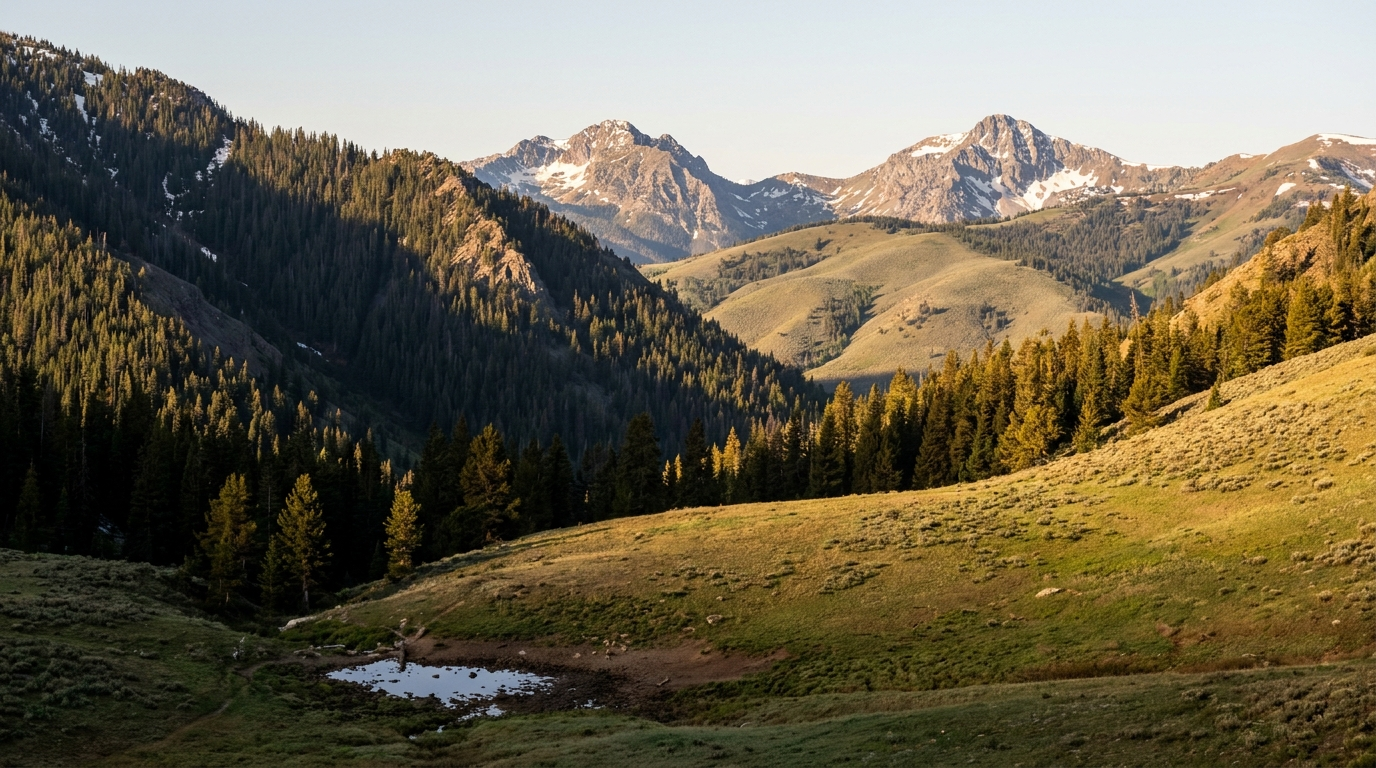
A single elk unit in Colorado, Wyoming, or Idaho can run 100,000 acres of public ground, sometimes more. Four scouting days, maybe five if the drive doesn't eat the trip, won't cover that on foot. It's plenty to eliminate ninety percent of it before you ever load the truck, if you spend those days on a laptop first instead of a trailhead.
E-scouting isn't a substitute for boots on the ground. It's a filter. The goal isn't to mark an X and show up in September expecting a bull standing there — it's to walk into a new drainage already knowing where the water is, where the timber holds shade past ten in the morning, and which ridgelines everyone else is already glassing. Here's how to actually use the tools instead of just staring at satellite tiles.
Confirm access before you fall in love with terrain
Before anything else, overlay public and private land boundaries on whatever mapping app or GIS layer you're running, then check the travel management plan for that specific forest or BLM district. Roads that show as open on a five-year-old base map get gated or seasonally closed constantly, and a route that looks driveable in August might be walk-in only during rifle season. This step takes ten minutes and saves you from building a whole scouting plan around ground you can't legally reach in the timeframe you're hunting.
Let water do the filtering in dry country
In most western units, water is the tightest bottleneck elk deal with all summer and into September. On satellite imagery, look for the color shift from dark green to a lighter, almost lime green — that's usually moisture in the vegetation, and it flags springs, seeps, and stock tanks that don't show up as blue lines on a standard topo. Cross-reference every green patch you find against the topo layer underneath it. A seep sitting in a flat pocket surrounded by tight contour lines, with dark timber close by, is worth a pin. A seep sitting in the open with no cover nearby usually isn't — elk will use it, but they won't bed near it.
Read contour lines for bedding, not just elevation
Topo maps tell you more about where elk sleep than most hunters give them credit for. Two things to hunt for specifically:
- Benches — spots where tightly packed contour lines suddenly spread out on an otherwise steep slope. That flattening is a shelf, and on a north- or east-facing aspect with timber cover, it's textbook midday bedding.
- Saddles — two contour lines shaped like U's with their open ends facing each other, usually sitting in the low point between two peaks or ridge points. Saddles funnel travel between drainages and make good pinch points for both scouting cameras and, later, a stand-and-wait setup.
North and east-facing dark timber holds elk through the heat of the day because it keeps shade longest. If a bench or saddle sits on one of those aspects and connects to a water source you already flagged, that's a real candidate, not a guess.
Wallows are worth zooming all the way in for
Wallows show up on satellite imagery as small, dark, muddy patches, usually tucked into the bottom of a draw or right next to a spring. They're easy to miss at a normal zoom level and easy to spot once you're looking specifically for mud instead of water. During archery season, a wallow a bull is actively using can be worth a full midday sit — bulls will come in to roll and re-scent through the hottest part of the day, when glassing elsewhere has gone dead. Flag every wallow candidate you find near a bedding area, even ones you're not sure about. You'll rule most of them out on the ground in about thirty seconds.
Cross-reference pressure before you commit
A gorgeous basin an hour from a paved trailhead gets hunted hard, and public GPS and mapping apps increasingly show crowd-sourced pressure and app-usage heatmaps for exactly that reason — busy areas light up. Use that layer as a tiebreaker between similar-looking spots. As a rough baseline, look for places where good water, bedding, and feed all sit within a mile of the nearest motorized road or trailhead — that distance alone knocks out a big share of the pressure without requiring you to plan a five-mile pack-in on your first trip to a new unit.
Do this work in July, not August
The window for this kind of scouting is narrow and it's open right now. Draw results are already posted in most western states, leftover and OTC lists are dropping through July and into early August, and archery elk season opens in a matter of weeks in most units. Once you've got a tag in hand, every week spent staring at a screen instead of narrowing a shortlist is a week you won't get back before opening morning. If you're still deciding between units because your first choice didn't come through, do the e-scouting pass before you commit to a drive, not after.
Build a shortlist, not a plan
Come out of an e-scouting session with three to five candidate basins, not one. Terrain looks different in person than it does from directly overhead, water sources dry up or get fenced off, and a burn that looked promising on last year's imagery might be five years further into recovery than the photo shows. Treat every pin as a hypothesis to test at first light, not a location to defend. The hunters who get burned by e-scouting are the ones who show up committed to a single spot instead of a list of them.
Trust the map to eliminate ground. Trust your eyes to pick the winner.
What the imagery won't tell you
Satellite imagery lags — sometimes by a full season, sometimes longer in remote country. A clear-cut logging operation, a fresh wildfire, or a beetle-kill deadfall event can rewrite a drainage in ways the app hasn't caught up to yet. Before you commit real scouting days to a spot, check current-year fire and closure info for that forest directly, not just what's layered into your mapping app. And remember that regulations, unit boundaries, and access rules shift year to year — verify all of it against your state's current-year hunting regs before you build a season around it.
If this is your first year in a new state after not drawing your first-choice tag, the OTC decision itself matters as much as the scouting — pick a unit with realistic access before you start burning e-scouting hours on it.
The gear the map sends you toward
Once you've got a shortlist, the next move is confirming it with glass instead of feet — a full morning behind good binoculars and a spotter will rule spots in or out faster than hiking to each one. Current optics deals are worth checking before a new-unit trip, since a tripod-mounted spotter earns its keep glassing a basin from the road before you ever commit to hiking into it.
Pressured public-land elk also get scent-educated fast, which is part of why ozone and scent-control gear has become standard kit for hunters working the same drainages other people are — Ozonics units run deep discounts right now if you've been putting off adding one to the kit. And whatever basin your e-scouting turns up, you'll want a pack built for the actual pack-out, not just the hike in — the difference between a day pack and a meat-hauling frame matters a lot more once there's an elk down three miles from the truck.
For the glassing side of this once you're on the ground, the western hunting glassing system guide walks through building out the optics kit itself. E-scouting gets you to the right drainage. Everything else on the homepage is built around getting you outfitted for what happens once you're standing in it.