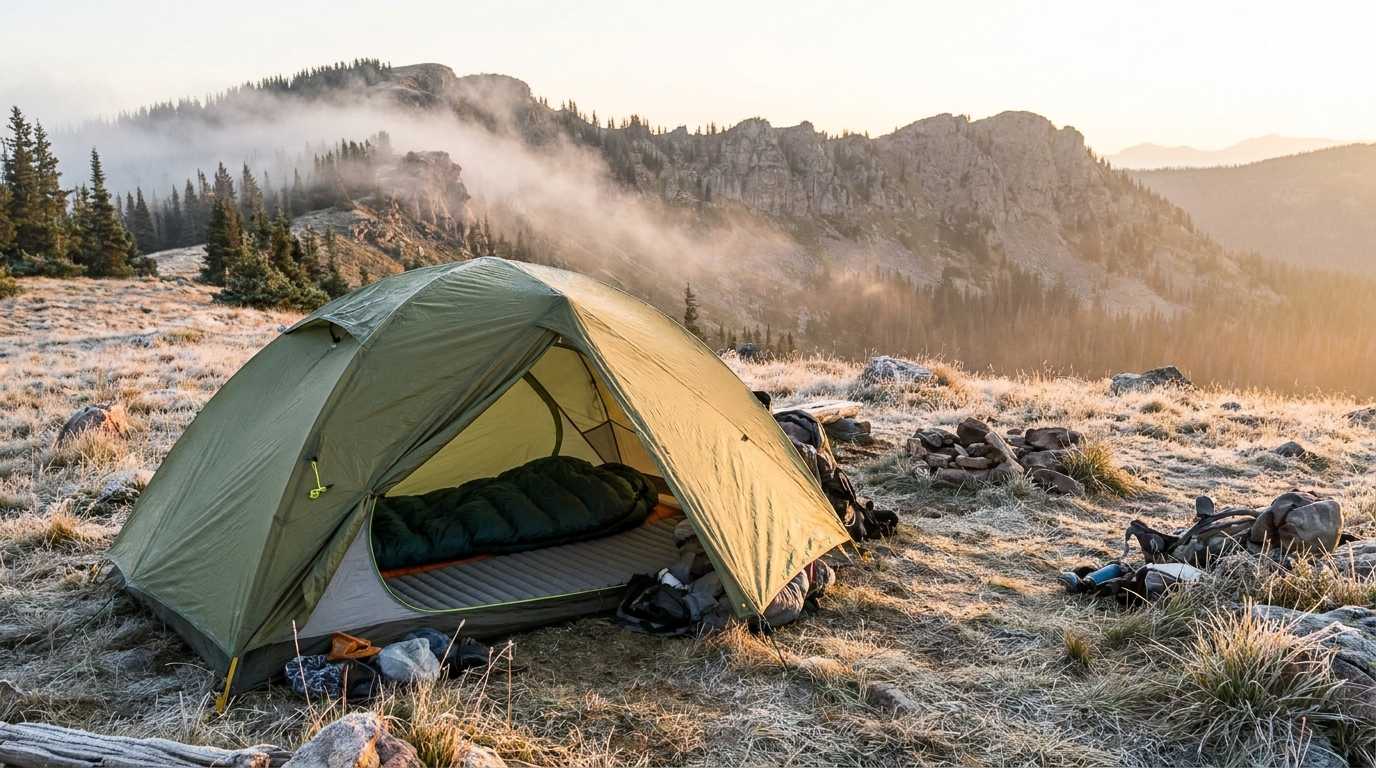
Ground pulls heat out of a sleeping body roughly 25 times faster than still air does. That single fact is why so many hunters buy the wrong piece first. They drop real money on a 0-degree bag, then bed down on a thin pad they had left over from summer car camping, and wonder why they woke up shivering at 2 a.m. in a September spike camp at 9,500 feet. The pad, not the bag, is usually where a backcountry sleep system fails.
If archery elk, mule deer, or sheep and goat scouting is on the calendar in the next couple months, now is the window to sort this out — before the trailhead, not at it.
Three pieces, not one
A sleep system is the bag or quilt, the pad underneath it, and whatever you're doing to keep your head warm and dry. Buy any one of those in isolation and the whole system underperforms. A 15-degree bag on a low-R-value pad sleeps colder than a 20-degree bag on a good one, because the pad is doing more of the thermal work than most people assume.
The industry testing standard, ASTM F3340, exists so bag temperature ratings mean roughly the same thing across brands. There's a catch worth knowing: those ratings assume you're using a pad with an R-value of 5 or higher underneath. Pair a 20-degree bag with a 2.0 R-value backpacking pad and you are not sleeping in a 20-degree system. You're sleeping colder than that number promises, and you'll find out exactly how much colder somewhere around midnight.
R-value is the number that actually matters
R-value measures a pad's resistance to heat loss into the ground. Higher is warmer. A pad rated 4.0 insulates roughly twice as well as one rated 2.0 — not a marginal difference, a doubling.
Rough guidelines that hold up across most backcountry pad options on the market:
- R 1.5–2.5 — warm-weather only. Fine for an August scouting trip or an early velvet bear hunt where nights stay above 50.
- R 3.0–4.0 — the three-season range most elk and mule deer hunters actually need. Covers a wide swing of September and October nights.
- R 5.0 and up — late season, November rifle camps, anything where overnight lows are flirting with the teens or below.
Weight and R-value trade against each other, and that trade-off is exactly what separates gear picked for a car-camping trip from gear picked for a pack-in hunt. The lightest pad you can find with the R-value your hunt actually needs beats the warmest pad you own if that warmest pad weighs three pounds and eats a third of your pack volume. Stack two lighter pads — a closed-cell foam pad under an inflatable — and R-values add together, which is a real trick for shoulder-season trips where conditions might swing 40 degrees in a week.
Bag or quilt: the actual trade-off
Rokslide and Hunt Talk threads on this question run for pages every August, and the disagreement is mostly people talking past each other about different trips. Here's the honest version.
A sleeping bag insulates your entire body, including the parts touching the pad, and its temperature rating is more predictable because there's no draft management on your end. For most hunters, in most conditions, a bag is the safer call — especially on a first backcountry hunt where you don't yet know how you sleep at altitude or how your body handles a cold night in a bivy.
A quilt cuts weight and pack volume by removing the bottom half of the insulation, on the logic that a compressed pad already handles ground-side warmth better than compressed bag insulation would anyway. That logic is sound, but it shifts real responsibility onto you: how well you cinch the footbox, how well you seal the draft collar around your neck, whether you're using a pad wide enough that you don't roll off the edge into open air at 3 a.m. A quilt rewards hunters who've dialed in their system already. It punishes hunters who haven't.
September archery elk is the clearest example of why this decision isn't universal. Season dates run from mid-August into October depending on the state and the unit, and overnight temperatures across that window can run anywhere from the 70s down into the 20s — sometimes with snow on the ground before the season's even a week old. A quilt earns its keep on the hot, dry stretch of that calendar. A bag earns its keep on the cold, wet stretch. If you're hunting one specific week you know something about, match the tool to it. If you're hunting a long season with real temperature uncertainty, the bag is the fewer-ways-to-go-wrong choice.
Matching the system to the actual trip
Don't buy one sleep system and force it to cover every hunt on the calendar. A late-July or August scouting trip into sheep or goat basins wants light and warm-weather rated — you're moving fast, covering glass points, and the low temps are genuinely mild. A mid-September elk hunt wants a three-season setup with margin, because a cold front dropping snow on opening week is common enough that "it probably won't happen" isn't a plan. A November rifle camp, or anything in late-season whitetail country from a wall tent or truck camp rather than a pack frame, wants the heaviest, warmest gear you own — weight matters far less when you're not humping it five miles uphill.
If you only own one system and it has to flex across that whole range, build it around layering rather than a single bag rated for the worst night you might hit. A 20-degree bag plus a lightweight liner and a puffy jacket worn to bed covers more range than a single-purpose 0-degree bag that's overkill nine nights out of ten and gets left at home on the tenth.
Keeping it dry and functional in camp
Down loses almost all of its insulating value when it gets wet, and a multi-day pack-in hunt is a long string of chances for that to happen — condensation inside a tent, a sweaty hike into camp at the end of a hot afternoon, a leaking water bladder in the same pack compartment. Synthetic insulation costs more in weight and pack volume for the same warmth, but it keeps insulating even damp, which matters more on a wet coastal blacktail or waterfowl-adjacent hunt than it does in the dry Rockies.
In camp, get the bag or quilt out of its stuff sack the moment you stop for the night so loft has time to recover before you actually need the warmth. Sleeping in slightly damp base layers instead of your hiking layers keeps sweat out of your insulation. And don't underestimate what a dry set of socks and a buff over your face does for perceived warmth — a system rated correctly on paper still feels cold if you climbed into it soaked from a stalk that went long.
Packs matter here too. A sleep system with real R-value margin tends to be bulkier, and cramming an oversized bag into an undersized pack body is how compression straps fail on day three. If your current pack setup is already tight before you add a sleep system built for the actual conditions, the pack is the piece to fix first — check current pack deals before the season, not after a strap blows on the mountain.
What to actually buy this month
Big Agnes builds sleep systems specifically aimed at the backcountry hunting crowd, and the brand runs deep discounts on tents, bags, and pads through Timberline right now — worth a look at Big Agnes's current lineup if you're filling gaps before archery season opens. For pads, sleeping bag liners, and the smaller pieces that round out a system, the current accessories deals are a reasonable place to start, since pricing on this stuff shifts by the week.
Get the pad decision right first. Match the bag or quilt to the specific trip, not to a hypothetical worst case. And if the rest of your kit needs a look before opening day, the pre-season gear audit covers what else tends to fail at the worst possible moment. Browse today's deals while you're at it — the discounts move fast enough that the good stuff doesn't sit long.