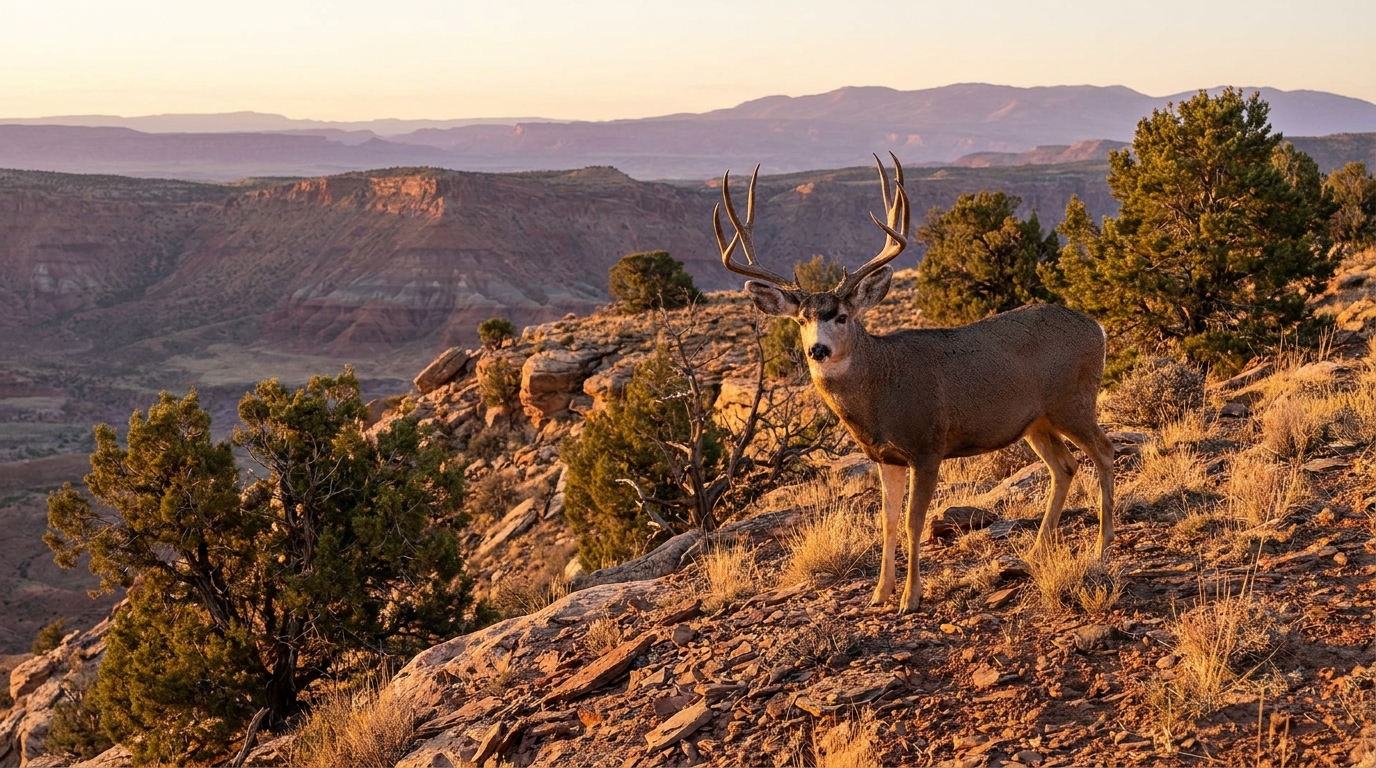
Most hunters blow a stalk before they take the first step. They glass up a buck, pick a general direction, and start walking — figuring out the details along the way. That's how you burn a perfect morning.
The approach plan has to happen from your glassing position, at distance, while you can still see the deer. The moment you stand up and start moving, you're committed. Terrain won't let you reroute cleanly, and a buck that shifts 50 yards while you're in a draw will be gone when you crest the ridge.
This is mostly about the planning phase. Getting close enough to shoot isn't the problem most hunters have. Getting there without being winded is.
Sit More Than You Walk
Whitetail hunters switching to mule deer make the same mistake: they want to cover ground. They're used to hiking to a stand or still-hunting timber, so open country makes them feel like they should be moving. Mule deer country punishes that.
The best mule deer hunters sit more than they walk. A morning on a ridge glassing a canyon outproduces four miles of boots on talus. You're hunting with your eyes — binoculars are the primary tool, not the rifle or the bow. The stalk only makes sense after you've found the deer, identified a mature buck worth chasing, and watched him long enough to know where he's going.
That shifts how you plan the day. Pace matters less than optics quality.
Glassing Setup and System
Find a vantage point that covers as much terrain as possible without putting you on a skyline. Saddles, knobs above a canyon, the back side of a ridge where you can peek over — positions where you settle in, stabilize your glass, and work the country methodically.
The method: divide terrain into sections and spend real time on each one. Not scanning — looking. Thirty seconds minimum per patch of brush or shadow. A bedded buck showing only an antler tip doesn't announce himself.
Quality glass makes the difference at this stage. Spending two hours picking apart a canyon at 600 yards requires optics sharp enough to read ear movement in a juniper shadow. The Vortex Razor UHD 10x50 and 12x50 are what serious hunters carry in western big game country — Alaska Guide Creations has both paired with their bino harness systems at a significant discount right now. The harness matters because you're wearing the glass all day, not pulling it from a pack.
Once you find a buck worth stalking, swap to a spotting scope and study the approach route before you move. Look for drainages that give you a natural conduit toward the deer, benches that put you at the same elevation rather than below, rock outcroppings that break your silhouette. Outdoorsmans has the Vortex Razor HD 13-39x56 and the Razor HD 27-60x85 spotters running deals right now. At this planning stage, a quality spotter isn't a luxury — it's how you find your route before you're committed to it.
Where Mule Deer Are by Time of Day
Mule deer move with temperature and thermals, not a fixed schedule. The pattern is reliable once you understand it.
Early morning: Bucks feed in the dark and into first light on open slopes, drainage heads, and flats near ridgelines. They're moving. You have a window before they head for shade.
Mid-morning: By 9 or 10 a.m. most deer are bedded. They pick spots with a view in front and wind at their backs — a rock outcropping on a north slope, the junction of two ridges, anywhere that lets them see and smell trouble coming. A lot of hunters pack up and head back to camp right about now.
Don't.
Between 11:30 a.m. and roughly 2:30 p.m., thermals are at their most stable. The sun has fully heated the terrain, air is rising at a consistent rate, and you can read wind direction with real confidence. The buck has been in his bed for two hours and isn't going anywhere soon. A stationary deer in stable air is the best setup for a spot-and-stalk approach, especially with archery equipment.
Evening: Deer get up an hour or two before dark and move back toward feed. Thermals are falling by then, draining down into valleys and bottoms. Keep that in mind when picking your glassing position for evening — you want to be above the air movement, not inside it.
Planning the Stalk Before You Move
The question most hunters skip: where will the deer be when you arrive?
A mule deer stalk in open country takes 30 to 60 minutes depending on terrain. If the buck is feeding when you start, he'll drift while you're in the drainage losing visual contact. If he's bedded, he'll stay — until he doesn't.
Before you leave your glassing position, do three things.
Pick a specific landmark near the deer's last position — not "over by that ridge" but "ten yards left of the lone juniper below the tan rock band." When you lose visual on the approach, that landmark is your reference point.
Map the route in segments. Identify the first piece of cover you'll move behind, then the next, then where you'll close the final distance. Drainages are your best asset — they provide concealment, break your silhouette, and often channel air in a predictable direction.
Identify where your scent goes relative to the buck's position. Then think about what changes as you move. At what point does your route shift from downwind to crosswind? Is there a drainage that could funnel air differently once you're inside it? Those transition points are where stalks unravel.
What Thermals Actually Do Mid-Stalk
You check wind at your glassing spot — it's in your face, you're confident. Twenty minutes later the air is swirling and you have no idea where your scent is going.
Small terrain features create micro-thermals that don't match the overall drainage pattern. A south-facing rock wall catches sun earlier than the surrounding slope and pushes warm air outward. A shaded draw holds cold air from overnight, releases it upward mid-morning, then reverses in the afternoon. None of that is visible from a ridge a quarter-mile away.
The habit to build: check your wind indicator constantly on approach. Not once at the start — every few minutes, and without fail before you cross any ridge or expose yourself. Milkweed floss or an unscented powder squeeze bottle both work fine.
If the wind does something you didn't plan for, stop and wait. A bedded buck in stable midday conditions will hold his position for hours. You can afford five minutes to let the air settle before pressing forward.
The Last 80 Yards
Most stalks die here. You're close, antler is visible, and you rush. You want to close the distance before something changes.
Slow down instead.
The final stretch needs to be silent and deliberate — one step at a time, feeling each footfall before committing weight. Your pack needs to be cinched tight so nothing shifts or rattles; the Forloh Method Pack System stays locked against your back without loose straps flopping, and it's marked down from $825 to $250 right now. Clothing should move quietly through sage and dry grass on the final approach.
Mule deer are more deliberate than whitetail when something alarms them. They stop, stare, and try to figure out what they saw before committing to a decision. Freeze when a buck raises his head. Hold position until he looks away — and most of the time he will, after 30 to 60 seconds of staring. Move only after his head drops. One rash step at 70 yards after executing the first 400 yards perfectly is how the whole morning ends.
Gear That Actually Matters
The list is shorter than most gear articles suggest.
Optics: Binoculars around your neck, always. Spotting scope in the pack for route planning and buck identification. This is where to spend money on a mule deer hunt — current deals on binoculars and spotting scopes cover a wide range of price points. Quality glass pays back every day you spend behind it.
Pack: Something with a frame, or frame compatibility. A frameless daypack handles the approach, but when you're 4 miles from the trailhead with 70 pounds of meat and hide, you need structure. The Forloh Method 4400 Pack Body takes a frame insert and does both jobs — running at $250 from $825 right now.
Footwear: Quiet and grippy on rock. Break them in before the hunt. Blisters end stalks faster than bad thermals.
Wind indicator: Non-negotiable. Use it every few minutes, not once at the truck.
Everything else is secondary to those four things. Find deals on optics, packs, and western hunting gear at Timberline Deals.