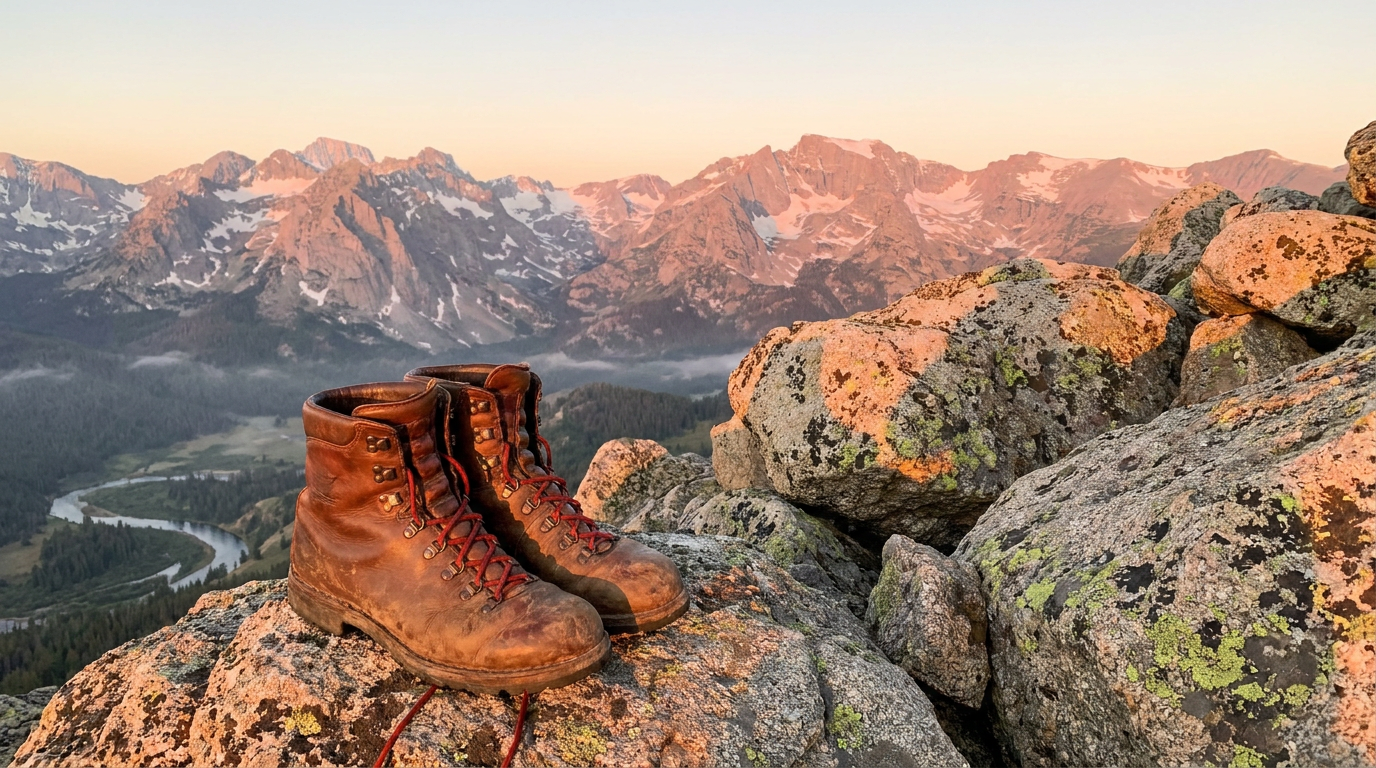
The boot decision is the wrong kind of expensive to get wrong. Too soft and you're side-hilling a steep slope with no real platform under your foot. Too much insulation and you've soaked your socks before shooting light. Wrong width and you've got a hot spot on your pinky toe at mile 4 that turns into a blister by mile 7 and costs you ground by day 3.
Most boot guides list popular models and call it done. This one covers the decisions behind the decisions — because the right boot for elk country in central Idaho is not the same boot you want on a Dall sheep hunt in the Wrangells.
Stiffness: The Spec That Actually Separates Hunting Boots from Hiking Boots
A shank is the rigid support structure built into a boot's midsole. It prevents the boot from twisting under lateral load — which is exactly what happens when you're traversing a steep slope at 9,200 feet with 55 pounds on your back. A stiff shank creates a level platform under your foot so the mountain's angle doesn't transfer directly into your ankle and calf. A flexible shank means your stabilizing muscles absorb that work instead. At mile 2, that's manageable. At mile 10 on day 4, it's what ends your hunt early.
The GoHunt flex scale runs 1 through 5:
- Flex 1–2: Light and fast. Good for flat pronghorn country, short approaches on established trail, or early-season hunting with a minimal pack.
- Flex 3: The most versatile rating. Archery elk, general mule deer terrain, sustained hiking on moderate grades.
- Flex 4: High-country elk, technical mule deer, extended side-hilling with a full load.
- Flex 5: Sheep and goat country. Crampon-compatible. Designed for terrain where softness is a liability.
Most elk and mule deer hunters on western public land need Flex 3 or Flex 4. Most of them own hiking boots that run Flex 1 to 2. That's the gap between comfortable approaches and feet that give out before legs do.
The Insulation Mistake That Costs the Most Hunters
More insulation sounds like more protection. Four hundred grams sounds warmer than two hundred. But insulation ratings are static-condition numbers — they measure warmth when you're standing still. They say nothing about what happens when you're hiking hard up 2,000 feet of gain in the dark, your body generating heat faster than any rating accounts for.
September archery elk is the clearest case. Trailhead temperature might be 42°F. Most hunters are wearing 400g boots because they're afraid of cold. By the time they reach their glassing bench, both socks are soaked through with sweat. Then they stop moving. Now they're standing at first light on a ridge at 10,500 feet in wet socks inside waterproof boots, with nowhere for that moisture to go. Cold feet follow — not from too little insulation, but from too much of it.
Zero-gram boots with a quality merino wool sock handle September archery hunting better than 400g boots for most hunters doing serious miles. Wool wicks during hard effort and retains warmth when damp in a way synthetic materials don't match.
A working guide by hunt type:
- 0g: September archery, high-mileage early season, warm conditions with sustained movement
- 200g: October rifle, mixed-pace hunting — the sweet spot for most western deer and elk seasons
- 400g+: Late season, long cold sits, stands over bait, or if you run cold regardless of activity
Match your insulation to your activity level, not just the temperature forecast.
Waterproofing: When GTX Actually Makes Things Worse
Gore-Tex keeps water out. It also traps vapor in. Under hard effort, feet produce more moisture than any breathable membrane can exhaust — internal humidity inside a GTX boot can reach equilibrium with outside air during steep climbing, at which point vapor stops moving through the membrane. The boot hasn't failed. You've just outpaced what the system was designed to handle.
For hunters covering long dry miles — early-season Nevada mule deer, Colorado elk in late August — a non-waterproof boot with good breathability will keep feet drier over a full day than a GTX boot will. Walk through a creek in a breathable non-waterproof boot and your feet get wet, then dry out in two to three hours of continued hiking. Walk through a creek in a GTX boot and the water that splashes in over the collar has no exit route.
GTX earns its place in genuinely wet conditions: British Columbia mountain goat in September, rainy Oregon elk, hunting through early Montana snow. If sustained water exposure is the bigger risk than sweat buildup, waterproofing is the right trade-off.
Know your actual hunt conditions before you decide.
Fit: What You Cannot Fix Once You're on the Mountain
Your heel should not move. That's the fit criterion that matters most.
Even a few millimeters of heel lift with each step produces friction. Friction on a seven-day backcountry hunt produces blisters that take you out of the game. When trying on boots, wear the socks you'll actually hunt in, find a downhill grade — outside the store, on stairs, anywhere — and load your weight into the downhill foot. Heel lift shows itself under exactly that kind of pressure. If you feel it in the store, you'll feel it at mile 6.
One finger-width of clearance between your longest toe and the boot tip when standing is standard. Descents on technical terrain push your toes forward, and a toe box that's too close means bruised nails before the third day.
Width is where fit diverges between the major brands. Crispi is built on an Italian last — narrower through the heel and midfoot, tapered toe box. It fits narrow to medium feet well and typically requires less break-in time than most comparable boots. Kenetrek runs wider and offers multiple width options, which makes it more adaptable for harder-to-fit feet but demands more patience through break-in.
The Crispi Anchor-Point shows up at a deep discount with some regularity — a legitimate mountain hunting boot built for elk and mule deer terrain, not a hiking boot with a camo colorway. Browse the full boots listing to compare current deals and available inventory.
For hunters with genuinely hard-to-fit feet, or those who cover enough mountain miles each year to justify the investment, Lathrop & Sons builds custom boot systems at their Guide/Outfitter level. Custom fit is the right answer for a specific hunter — one who has burned through multiple off-the-shelf options trying to solve a fit problem that standard lasts don't address.
One thing most guides skip: try boots in the afternoon. Feet swell through the day, and they also swell at elevation — sometimes a full size up at 9,000 feet compared to sea level. A boot that fits correctly at 9 a.m. in a flatland store can feel wrong by day two in the high country.
Break-In: The Six Weeks Most Hunters Skip
Quality mountain boots are stiff out of the box. That's not a flaw — it's the foundation of the support and durability you're paying for, and there's no shortcut around it.
Kenetrek's own recommendation is 50 miles of break-in before hunting. Short daily sessions over six to eight weeks — 30 to 60 minutes of purposeful hiking on varied terrain — work far better than occasional long days. Consistent repetitive flex lets the leather conform to your foot gradually. Trying to accelerate the process with heat damages leather and stiffens it back worse than before.
Crispi breaks in faster than Kenetrek for most foot shapes. Some hunters report near-immediate comfort; others need a few weeks. Faster break-in is not the same as no break-in.
What ruins a boot faster than hard miles: applying waterproofing treatment before break-in is complete. Sealing the leather early slows the conforming process.
Buy boots in June for a September hunt. That's the discipline the mountain rewards.
Finding What's on Sale Right Now
The boots category at Timberline rotates deals on hunting-specific footwear from brands with genuine backcountry credibility. Your boot decision connects to everything else in your kit — what you carry in your pack affects how many miles your feet need to hold up, and your base layer choices affect how well your insulation budget holds through a full day of mixed effort.
See everything currently on sale across western hunting gear at Timberline Deals.