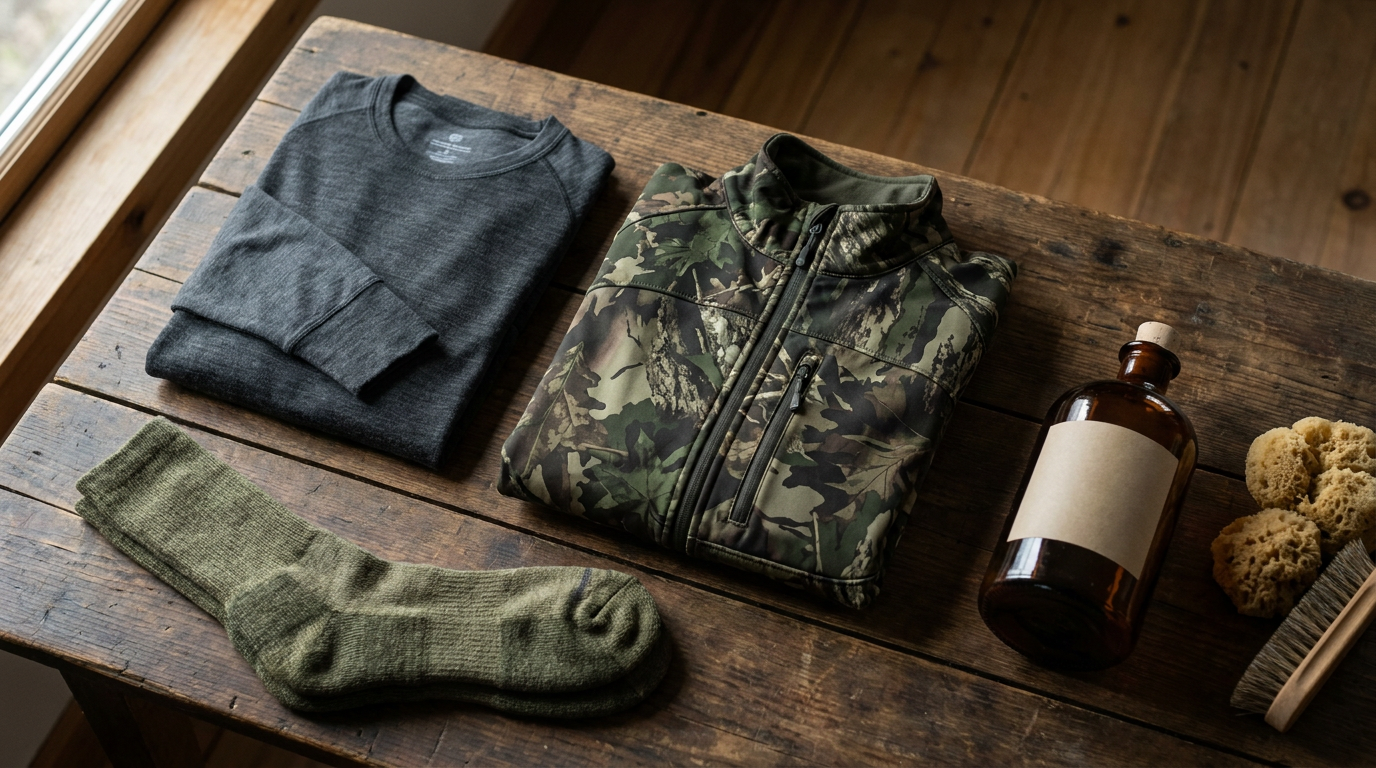
Your hunting clothes are some of the most expensive gear you own. A single merino hoody or a serious rain shell can cost more than a rifle scope. Yet most hunters do one of two things wrong: they never wash their kit because they are scared of killing the scent control or the waterproofing, or they throw it in with the family laundry and quietly destroy a $300 layering piece with fabric softener and a hot dryer.
Neither is right. Technical hunting apparel is built to be washed. You just have to wash it the way it was engineered to be washed. Here is how to do it by fabric type, which products actually matter, and how to bring dead waterproofing back to life.
The one rule that prevents most damage: sort by fabric, not by color
The fastest way to ruin good gear is treating a merino base layer, a waterproof shell, and a puffy like they are the same load. They are not. Each is built around a different technology, and the things that clean one will wreck another. Before anything touches water, separate your kit into four piles: merino/wool, synthetics, anything with a waterproof (DWR) finish, and down insulation. Then work through them with the right approach below.
And before you start, throw out one product entirely: fabric softener. It coats fibers in a waxy film that flattens merino, clogs the breathability of synthetics, and kills water repellency on shells. It has no place anywhere near hunting clothes.
Merino wool base layers and mid-layers
Merino is the workhorse of a backcountry layering system, and it is also the most commonly murdered fabric in the dryer.
- Cold water, gentle cycle. Heat and agitation are what shrink and felt wool. Use the wool or delicate setting and cold water.
- Scent-free detergent only — a wash made for hunting apparel, or a plain fragrance-free, dye-free, brightener-free detergent. No bleach, ever.
- Air dry flat. This is the big one: never put merino in the dryer. Lay it flat or hang it to keep its shape. A hot dryer can shrink a base layer a full size and break down the fibers.
- Wash merino less than you think. Wool is naturally odor-resistant, so a few wears between washes is normal and actually extends its life. Air it out overnight before assuming it needs a cycle.
Brands like First Lite and Smartwool build their lines around merino, and their care instructions all land in the same place: cold, gentle, scent-free, and absolutely no heat drying.
Synthetic base layers and fleece
Polyester and nylon synthetics are more forgiving than wool, but the rules barely change. Wash cold or warm on a normal cycle with a scent-free detergent, and skip the high-heat dryer — tumble on low or air dry. High heat can melt or pill synthetic fibers and degrade any stretch in the fabric. If your synthetics are holding onto funk (synthetics trap odor more than wool does), a dedicated technical/sport wash will strip the bacteria better than regular detergent without leaving fragrance behind.
Softshells, rain gear, and anything with a DWR finish
This is where most hunters get nervous, and where the right process actually brings gear back from the dead.
Your rain jacket, your softshell, and your insulated outer layers rely on a DWR (durable water repellent) finish — a microscopic coating that makes water bead up and roll off instead of soaking in. DWR wears off with time, dirt, body oils, and washing. When your shell starts "wetting out" (the face fabric soaks dark instead of beading), the membrane underneath can't breathe and you feel clammy and cold. The fix is two steps:
- Clean it with a technical wash, not regular detergent. Products like Nikwax Tech Wash or Grangers Performance Wash clean waterproof gear without leaving the residue that normal detergent does — residue that actively attracts water and makes wetting-out worse. Regular detergent on a rain jacket is part of why it stopped working.
- Re-proof it. After cleaning, restore the DWR with a wash-in treatment (added to the machine) or a spray-on treatment (applied to the damp garment, better when you only want to treat the outer face and not the lining).
Then reactivate the finish with gentle heat — a low tumble dry or a warm iron with a cloth between the iron and the fabric helps the DWR bond and bead again. Re-proof at the start of each season, or any time water stops beading on the shoulders and forearms.
Premium shell systems from Kuiu, Sitka, and Outdoor Research are all designed to be cleaned and re-proofed this way — a well-maintained shell will outlast two or three neglected ones.
Scent control is a system, not a bottle of detergent
It is worth being honest about this: a scent-free wash is one piece of scent control, not the whole thing. Washing in fragrance-free, UV-brightener-free detergent keeps you from adding scent and from glowing under a deer's UV-sensitive vision. But the detergent does far less than:
- Storage. Keep clean hunting clothes sealed in a tote, ideally with natural cover scent (dirt, leaves, pine), away from the gas, food, and pet smells of a normal closet.
- Dressing at the truck. Driving to the field in your hunting clothes loads them with exhaust, coffee, and gas-station scent. Dress on location.
- Wind discipline. No wash beats playing the wind. Treat scent-free laundry as the baseline, not the strategy.
Down insulation
Down puffies need their own approach. Use a down-specific wash (regular detergent strips the natural oils that keep down lofted), run a gentle cold cycle, and rinse twice so no soap stays trapped in the baffles. Drying is the slow part: tumble on low heat with a couple of clean tennis balls or dryer balls to break up clumps and restore loft. It can take a few cycles. Never store a down piece compressed — keep it loose so the fill stays alive.
The end-of-season reset
The best time to do all of this is when you hang it up for the year. A simple ritual that saves real money:
- Wash everything by fabric type, scent-free.
- Re-proof every shell and softshell so next season starts with beading water.
- Repair small tears and snags now, before they grow.
- Store dry, in sealed totes, with down kept loose and uncompressed.
Putting gear away clean and dry also prevents the mildew and permanent odor that ruin clothes left damp in a pack all winter.
A cadence you can actually keep
- Base layers and socks: every few wears, cold, scent-free, air dry.
- Outerwear and shells: a few times a season, technical wash, and re-proof the moment water stops beading.
- The 30-second test: sprinkle water on the shoulders of your rain jacket. If it soaks in instead of beading, it is time to clean and re-proof — not time to buy a new one.
Take care of your kit this way and a quality layering system will hunt hard for many seasons. And when it is time to add a piece, the smart move is to buy it on sale — we track real markdowns on the brands above every morning.