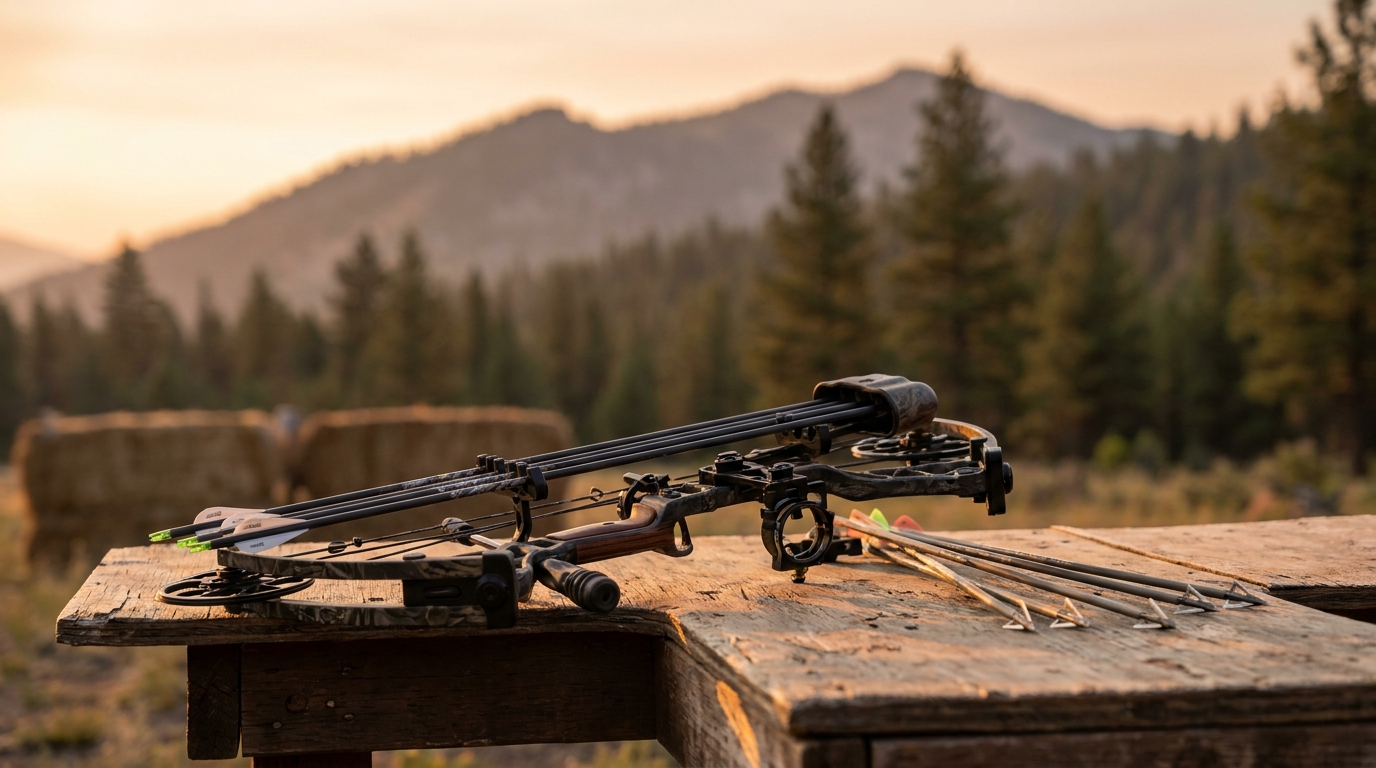
Sixty foot-pounds. That's roughly where kinetic energy needs to sit for a bow-and-arrow setup to reliably drive through elk hide, muscle, and bone at hunting distances — not the 40-45 ft-lbs that gets a whitetail through cleanly, but a meaningfully bigger number. Most bowhunters find that out the hard way, standing over a blood trail that goes twenty yards and quits. The fix isn't more poundage at the shop in August. It's the next eight weeks.
Archery elk season opens in early September across most Western states, which puts early-to-mid July right where it needs to be: late enough that your bow is back from any offseason work, early enough that you can actually fix what you find instead of duct-taping it together the week before you leave. Broadhead tuning, arrow building, and angle practice all take reps spread over time, not a single range session.
Broadhead-tune, not just paper-tune
Field points fly true almost regardless of what's wrong with your setup — they're symmetrical and forgiving. Broadheads expose everything. A cut-on-contact fixed blade or an off-center mechanical will find every flaw in your arrow spine, rest timing, and cam sync and turn it into a foot of drift at 40 yards.
The test is simple: shoot field points and broadheads at the same target, same pin, at 20, 30, and 40 yards. If the groups don't overlap, you have a tuning problem, not a broadhead problem. Work through it in this order:
- Spine first. An arrow spined light for your draw weight and point weight will porpoise or fishtail no matter how well the bow is tuned. Get your pro shop to check spine against your actual finished arrow weight, not the generic chart.
- Rest and cam timing second. Cam lean, poor rest containment, and out-of-sync cams on a two-cam bow all show up as broadhead drift that field points hide. This is a bow-press job — book it now, not in August when every shop in town is backed up.
- Fletching contact third. Vanes clipping the rest or the arrow shelf on the way out will steer broadheads sideways. Slow-motion video from behind the shooter catches this in a way your eyes at full draw never will.
If broadhead and field-point groups are still separated after that, walk-back tune it — shoot from 10, 20, and 30 yards at the same vertical line and adjust rest position until the groups stack. That's the setup that will hold at 40-plus yards when a bull finally gives you the shot.
Build the arrow for penetration, not just accuracy
Elk are a different animal than whitetail in exactly the way that matters at the moment of the shot: thicker hide, heavier bone, more muscle to drive through before the broadhead reaches the vitals. A tack-driving 350-grain arrow built for 3-D competition is the wrong tool here.
Most experienced elk hunters land in the 450-550 grain total arrow weight range, which delivers 60-70 ft-lbs of kinetic energy out of a typical hunting bow and enough momentum to punch through a shoulder blade if the shot goes a little forward. Front-of-center in the 13-16% range keeps that heavier arrow flying stable through broadhead-length drop without going so nose-heavy that it porpoises.
On broadhead choice: a tough single-bevel or cut-on-contact fixed blade is still the default recommendation for elk-specific hunts, because it keeps cutting through resistance instead of losing energy to opening blades mid-penetration. Mechanicals fly like field points and group beautifully on paper, but a rib or heavy shoulder muscle can rob them of enough energy to stop short. If you're set on a mechanical, build the rest of the system — arrow weight, FOC, draw weight — around penetration to cover for it.
Inspect what you can't see from the couch
A bow that shot perfectly last November doesn't stay that way sitting in a case for eight months. String stretch, wax dry-out, and a peep that's rotated a few degrees are all invisible until they cost you a shot.
- String and cables. Check for fraying, flat spots, or separating strands. Wax dry string before it cracks, not after.
- Peep alignment. Draw the bow with eyes closed, anchor, then open your eyes. If the peep isn't centered on the sight housing without you twisting to find it, it's rotated and needs correcting.
- D-loop and nock fit. A loose D-loop or a nock that doesn't seat with a consistent, light click introduces exactly the kind of inconsistency broadhead tuning can't fix.
- Every arrow, individually. Flex each shaft and listen for cracking, check inserts for play, and run a cotton ball down the shaft — it'll snag on hairline cracks your eyes miss. A cracked carbon arrow under full draw is a genuine safety problem, not just a lost-groups problem.
If you're also due for a glass upgrade, this is the same window to handle it — a scope or rangefinder with real angle compensation earns its keep the first time a bull shows up on a 35-degree slope. Outdoorsmans has been running deep discounts on demo and pre-owned glass that's worth a look before the current optics deals thin out ahead of season.
Practice the shot you'll actually get
Flat 40-yard shots at a 3-D target on level ground don't look anything like most real elk encounters. Elk live on slopes, and the shot that presents itself is more likely to be steep uphill or downhill, from a kneeling or braced position, with your heart rate somewhere north of resting.
The mechanics that go wrong on angled shots aren't about the angle itself — they're about form breaking down to chase it. Lock your form first: full draw, anchor, T-shape locked in. Then bend at the waist to acquire the target, uphill or down, instead of raising or dropping your bow arm. Raising the arm shifts your anchor and throws the sight picture off in a way that shows up as a miss high or low almost every time.
On distance, aim for horizontal distance rather than the line-of-sight number your eye gives you — a steep angle inflates apparent distance well beyond what gravity actually has to work against. An angle-compensating rangefinder does this math for you and is worth having in the pack regardless of what you're carrying it in.
Build angle practice into your routine now if you have any hillside within driving distance. A few arrows a day at real uphill and downhill angles, plus one longer session a week where you hike a target up a slope and shoot it coming back down, does more for September accuracy than another summer of flat-range groups.
The eight-week version of a practice plan
Spreading this out matters more than cramming it. A rough sequence that works:
- Weeks 1-2: Pro shop tune — spine check, cam timing, rest alignment. Build or buy your hunting arrows at final weight and FOC.
- Weeks 3-4: Broadhead-tune at 20-40 yards until groups match field points. Fix what the walk-back test reveals.
- Weeks 5-6: Add angle practice, kneeling and braced-standing positions, and shots after a short hike to introduce elevated heart rate.
- Weeks 7-8: Full simulation — pack on your back, position you'd actually be in, distance you'd actually take. Re-check broadhead groups once more before you leave; travel and temperature swings can shift a tune.
None of this requires new gear to start — a pro shop appointment and a hillside get you most of the way there. If your pack needs to hold up to that final full-simulation week the way it will in October, Forloh's current pack lineup is worth a look, and the broader pack selection covers everything from day packs to full meat-hauling frames if you're still deciding what to carry this season.
For the rest of the pre-season list beyond the bow — boots, layering, water treatment — the pre-season gear audit covers what else deserves attention before opening morning, and once your setup is dialed, elk calling in archery season is the next skill worth sharpening. Start here, though: a bow that's broadhead-tuned, an arrow built for penetration, and a shot you've practiced at a real angle beats a new piece of gear every time. Check out what's on sale right now at Timberline Deals while you're planning the rest of the kit.